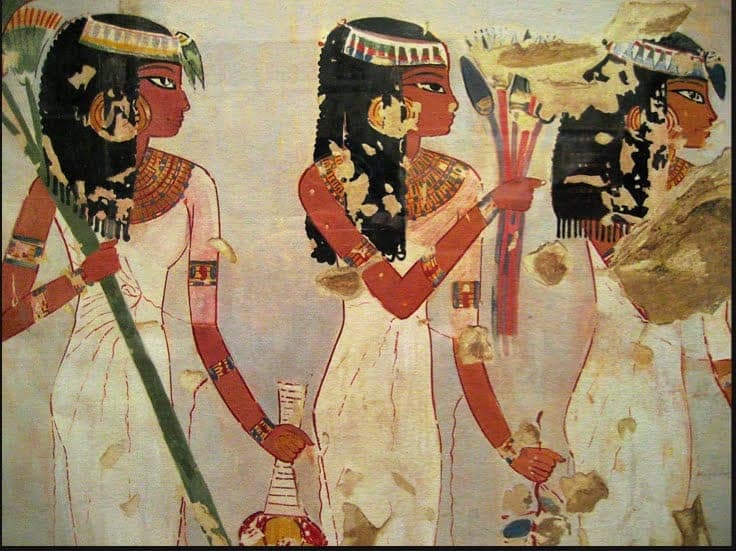
Weathered ancient Egyptian tomb painting showing three women in white dresses with elaborate black wigs and gold jewelry
Key Takeaways
The Festival of Drunkenness associated with the goddess Sekhmet is among the most cited ancient Egyptian examples of ritual involving intoxication and possible group sexual activity, though the sexual component remains debated.
Archaeological work at the Temple of Mut in Luxor has produced inscriptions linked to this festival, but interpretations of what those inscriptions prescribe versus describe differ among researchers.
Western accounts of ancient Egyptian sexuality have historically been shaped by exoticisation — the tendency to project outsider fascination onto another culture's practices in ways that often exceed the evidence.
Human societies across recorded history have constructed ritual, celebratory, or consensual contexts for group sexual activity — but each of these exists in its own cultural logic, not as evidence of a universal ancient tradition continuous with modern swinging.
The lifestyle community's intellectual inheritance is genuine: curiosity about consensual non-monogamy is not new. The specific historical claims are where honest skepticism is warranted.
Frequently Asked Questions
Did ancient Egyptians practice group sex rituals?
The archaeological evidence is suggestive rather than conclusive. Inscriptions at the Temple of Mut in Luxor have been linked by some researchers to the Festival of Drunkenness and interpreted as depicting group sexual acts. Whether those acts were a religious obligation, a documented outcome, or a symbolic representation remains genuinely debated among Egyptologists. The honest answer is "possibly, in specific ritual contexts" rather than "yes, they had orgies."
What was the Festival of Drunkenness?
The Festival of Drunkenness was an annual Egyptian celebration associated with the goddess Sekhmet, held to re-enact the myth in which the sun god Ra saved humanity by causing Sekhmet to drink heavily and fall unconscious, transforming into the gentler goddess Hathor. The festival involved drinking, music, and dancing. Whether ritual sexual activity was a formal component is the contested element — some researchers believe the evidence supports it; others are less certain.
Why are historical claims about ancient sexuality often unreliable?
Ancient sexuality scholarship faces several compounding problems: fragmentary evidence, interpretation filtered through the values of the scholars doing the interpreting, and a long history of Western writers projecting their own fascinations onto other cultures. Egyptian sexuality in particular was heavily exoticised by 19th- and 20th-century European accounts. Modern scholarship is more cautious — which makes the cautious interpretation worth taking seriously.
The internet is full of ancient Egypt's sexual reputation. Forum posts, lifestyle blogs, and popular history articles frequently cite the ancient Egyptians as precedent for group sex, communal sexuality, and what we might today recognize as swinging culture. The evidence used to support these claims is real — there are genuine archaeological findings and genuine scholarly debates. But the gap between the evidence and the popular account of it is wide enough to warrant a closer look, and being honest about that gap is more interesting than simply repeating the claims.
What the Archaeological Record Actually Shows
The most frequently cited evidence for ancient Egyptian group sexual ritual centers on the Festival of Drunkenness, an annual celebration associated with the goddess Sekhmet. The myth behind the festival describes the sun god Ra saving humanity by tricking Sekhmet — a lion-headed war goddess in the myth — into drinking vast quantities of ochre-colored beer, which she mistook for blood. She fell unconscious and was transformed into the gentler goddess Hathor. The annual festival re-enacted this myth through heavy drinking, music, and dancing.
Archaeological excavation at the Temple of Mut in Luxor has uncovered inscriptions associated with this festival. Some researchers have interpreted these inscriptions as depicting group sexual acts linked to the ritual context. The debate among Egyptologists is not about whether this festival existed or whether the inscriptions are real — it is about what the inscriptions prescribe versus what they describe, and whether the sexual element was a formal religious obligation, an informal outcome of mass intoxication, or something depicted symbolically rather than literally.
That distinction matters enormously. Research summarized by the Archives of Sexual Behavior on historical CNM scholarship cautions against reading modern sexual frameworks backward onto ancient evidence — a practice that tends to produce interpretations shaped more by the reader's expectations than by the historical record itself.
The Problem with the "Ancient Swingers" Narrative
Popular accounts of ancient Egyptian sexuality have a genealogy worth examining. The most exoticized versions of this history circulate in Western popular culture and trace not to Egyptian sources but to 19th- and 20th-century European writers who were simultaneously fascinated by and condescending toward other cultures' sexual practices. The tendency to project outsider fantasies onto ancient Egypt — framing it as a civilization that practiced what we wish we could — is a well-documented pattern in colonial-era orientalist writing.
Modern Egyptology has moved substantially away from these accounts. Contemporary scholars who work with the primary sources tend to be more cautious about what the evidence can support. This does not mean group sexual activity never occurred in ancient Egypt — it almost certainly did, as it has in virtually every human society. But the specific claims about institutionalized orgies, regular communal sex rituals, and a lifestyle-adjacent ancient Egyptian culture require more evidence than currently exists to be stated as established fact.
When we talk about history in the lifestyle community, we are often looking for validation — evidence that what we want has always been normal, that it has precedent, that we are not strange. That impulse is understandable. But the history of human sexuality does not need to be overclaimed to make the point. It really is true that humans have been curious about consensual shared sexuality across recorded history. The specific details of ancient Egyptian ritual are interesting precisely because they are uncertain — the honest version of the story is more compelling than the cleaned-up popular account.
— Long-time Swing.com members we've spoken with
What We Can Say with More Confidence
What is well documented, across multiple ancient cultures and multiple scholarly traditions, is that group sexual activity has occurred in ritual, celebratory, and consensual contexts throughout recorded history. Ancient Greece, Rome, and South Asia all have substantial historical records — including primary-source texts — that describe group or extra-dyadic sexual activity in various social contexts. The evidence is stronger and more direct for some of these traditions than for ancient Egypt specifically.
Research on the history of consensual non-monogamy, summarized in the Archives of Sexual Behavior and in the broader anthropological literature, supports the following general claim with reasonable confidence: humans have consistently, across cultures and eras, constructed social contexts in which group sexual activity occurred with some degree of consent and communal sanction. The specific forms those contexts took, the degree of individual consent involved (which varied enormously), and the cultural meanings attached to them are all historically specific and cannot be read directly into the present.
The Lifestyle Community as Inheritor — Not Descendant
The most intellectually honest framing for lifestyle-curious readers is this: the modern consensual non-monogamy community inherits a long human tradition of curiosity about and experimentation with non-dyadic sexual arrangements. That inheritance is real. It is also general and cultural rather than a direct documented lineage from ancient Egypt or any other specific civilization.
The lifestyle does not need ancient precedent to be legitimate. Its legitimacy rests on the consent, communication, and mutual enthusiasm of the people practicing it in the present. The interesting historical question — how have humans across time constructed consensual contexts for group sexuality? — is genuinely worth exploring. The answer is more varied, more uncertain, and more intellectually honest than the popular version allows.
Ancient Egypt remains a fascinating case precisely because the evidence is suggestive without being conclusive, and because the popular account has been so dramatically shaped by what audiences wanted to believe rather than what the inscriptions actually say. The honest story is more interesting than the exaggerated one. That is true of most history worth reading about.
Curiosity Without Overclaiming
On Swing.com, members bring genuine intellectual curiosity about the lifestyle's place in human history alongside their interest in the community. That curiosity is worth honoring with accurate framing. The Festival of Drunkenness may or may not have involved what we would call group sex. What it certainly involved was a community constructing a ritual space outside ordinary social constraints — which is, in some essential way, what the lifestyle has always been about, in every culture that has made space for it.
 Swing Editorial··4 min read