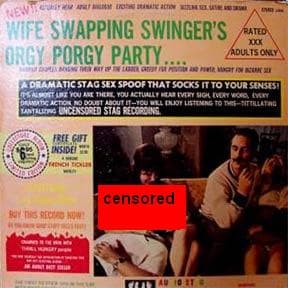
Vintage vinyl record sleeve titled Wife Swapping Swinger's Orgy Porgy Party with a censored photo and red XXX label
Key Takeaways
Academic scholarship — including work summarized by the Archives of Sexual Behavior and Kinsey Institute — documents consensual non-monogamy as a recognizable social phenomenon in postwar America, predating the 1970s cultural moment most people associate with it.
Before the internet, lifestyle couples connected almost exclusively through printed publications with monthly cycles — a process that could take months to produce a single compatible connection.
Regional print publications served as local community hubs, listing clubs, events, and personal ads for specific geographic areas.
The core values of the lifestyle — mutual consent, discretion, honesty between primary partners — have remained consistent across dramatically changing technology.
Digital platforms have dramatically lowered the barrier to entry, but also raised expectations; the fundamentals of respectful engagement remain unchanged.
Frequently Asked Questions
How did swingers find partners before the internet?
Before digital platforms, lifestyle couples connected primarily through printed magazines sold at adult bookstores. These publications carried personal ads, club listings, and community news. Monthly publication cycles meant the process of finding a compatible connection could take weeks or months. Regional publications served specific areas — a couple in the Pacific Northwest had different options than a couple in the Midwest — and the social network they enabled was necessarily smaller and slower than anything available today.
Is there historical scholarship on the swinging lifestyle?
Yes. Academic researchers — including work published in the Archives of Sexual Behavior and summarized by the Kinsey Institute — have documented consensual non-monogamy as a recognizable social phenomenon in postwar American suburbia, predating the 1970s cultural moment most people associate with "key parties" and swinger clubs. The pop-culture image of the 1970s swinger carries some historical truth but also considerable exaggeration; the actual social history is more varied and more ordinary than the mythology suggests.
Has the internet made it easier or harder to find compatible lifestyle partners?
Dramatically easier in terms of access and speed. Platforms like Swing.com give couples instant access to thousands of verified profiles, with search filters, preference matching, and event listings that would have been unimaginable in the print era. The challenge that has grown alongside the abundance is one of curation: with more options available, couples sometimes find that clarifying what they actually want is the harder work — a problem the older generation of lifestyle participants simply did not have.
Most histories of swinging begin in the 1970s, with the era's pop-culture shorthand — key parties, suburban pools, novelty-seeking Baby Boomers with sideburns. That image carries some historical truth, but it's an oversimplification that misses both what came before and what has endured. The lifestyle's actual history is more varied, more ordinary, and in many ways more instructive than the mythology.
What Academic Scholarship Actually Documents
Research summarized by the Archives of Sexual Behavior and the Kinsey Institute traces consensual non-monogamy as a documented social phenomenon in postwar American communities — earlier than most people assume. Academic historians of American sexuality have identified organized swinger networks emerging in the late 1940s and 1950s, partly among military communities where deployment cycles created particular relationship pressures and partly in suburban social networks where couples developed explicit arrangements outside conventional monogamy.
The 1970s were a period of greater cultural visibility rather than a point of origin. The era's loosening of some social constraints, combined with the advent of adult publications that could carry personal ads more openly, gave a pre-existing community better infrastructure. The cultural image of the decade shouldn't be mistaken for the community's birth.
What the research does not support is the romanticized image of the 1970s lifestyle as a consequence-free golden age. The actual documentary record shows couples navigating the same questions about jealousy, boundaries, discretion, and primary-relationship maintenance that remain central today. The technology was different. The human dynamics were not.
The Print Era: How Couples Connected
Before the internet — for several decades — the primary tool for finding compatible lifestyle partners was the printed personal ad, carried in magazines sold at adult bookstores. The process required patience that today's users rarely have to practice.
A couple would purchase a lifestyle publication, write a personal ad describing themselves and what they were looking for, pay for its placement, and wait. Because most publications ran monthly, a couple might wait four to six weeks just for their ad to appear. Then they would wait for responses, which arrived by mail. The entire cycle from first inquiry to first contact could take months — and that was for a connection that might still turn out to be geographically incompatible or simply not a match in person.
Regional publications served specific geographic communities. The Pacific Northwest had its own publications with local club listings and personal ads. Ohio, Texas, Florida, and other regions with larger populations had their own. A couple relocating from one region had to rebuild their community network from scratch, because the infrastructure was entirely local.
These publications weren't only personal ads. They carried club event listings, interview-style articles, community news, and readers' letters. They functioned as community hubs in the absence of digital forums — a place where the lifestyle community shared information, debated norms, and created a sense of continuity across an otherwise dispersed population.
What the Technology Actually Changed
The internet didn't transform the core values of the lifestyle — it transformed the infrastructure. Mutual consent, explicit communication between primary partners, discretion, and respect for other members' boundaries are as central to the Swing.com community as they were to the readers of a Pacific Northwest print magazine in 1985. What has changed is scale, speed, and access.
A couple today can create a profile on Swing.com, be verified, search for compatible members in their area, and exchange messages in the same evening. Events calendar listings update in real time. Photo verification reduces the uncertainty that made print-era ad responses genuinely risky — you had no way to know whether the description you'd read bore any resemblance to reality until you arrived in person.
People who've been in the lifestyle since before the internet describe the print era with a mix of nostalgia and relief. The patience it required meant that connections, when they happened, tended to be thoroughly vetted — you'd exchanged multiple letters, spoken on the phone, and often met publicly before anything else. That vetting happened slowly because it had to. What they miss isn't the slowness; it's the depth of the initial relationship-building that the slowness enforced. A few of them have mentioned that the Swing.com messaging and profile system gives them something of that back — a structured way to get to know someone before meeting.
— Long-time Swing.com members we've spoken with
The Abundance Problem
The challenge the digital era introduced is essentially the inverse of the print era's problem. Where print-era participants struggled with scarcity — few options, slow access, geographic limits — digital-era participants sometimes struggle with abundance. With thousands of profiles available, the question of how to choose, and what exactly you're looking for, becomes more acute rather than less.
This isn't a new observation, but it's worth naming clearly: the platform is a tool, not a solution. Two people who haven't had the direct, honest conversation about what they actually want and what they're not ready for will not find that clarity by browsing profiles. The communication practices the lifestyle demands exist independent of whatever technology facilitates the connections.
What Has Remained Constant
Across the print-magazine era, the early internet, and today's verified-profile platforms, a few things haven't changed. The lifestyle works when both partners are genuinely on board — not when one person has persuaded or pressured the other. It works when explicit communication is the norm, not the exception. And it works when participants treat other community members with the respect they expect for themselves.
The Swing.com community includes couples and solo members at every stage — newly curious, recently active, and deeply experienced. The event calendar gives couples a low-pressure starting point: a lifestyle social or community meetup where both partners can see the community in person before making any other decision. The platform's verified-profile system ensures that when a couple is ready to connect, they're doing so with real, active members rather than stale profiles or fabricated pictures.
The technology has changed dramatically since the days of rotary phones and monthly print runs. The community — its curiosity, its care for mutual consent, its discretion — has remained.
 Swing Editorial··4 min read