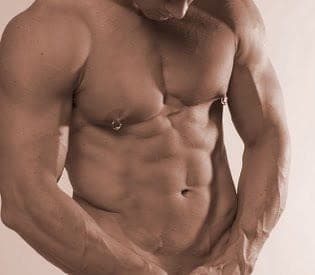
Close-up of a toned, muscular male torso with two pierced nipples, shot in warm sepia lighting
Key Takeaways
Attraction at lifestyle events spans a broader range of body types, ages, and presentations than popular coverage usually suggests — the community tends to be genuinely more welcoming of diversity than mainstream social settings.
Body modification including piercings and tattoos is a common preference for many participants but is not a universal attraction.
Fetish attire — leather, latex, rubber, silk — overlaps with BDSM communities at some events but is far from required at most lifestyle gatherings.
Age diversity is real: couples in their 40s, 50s, and 60s make up a significant portion of the active community, and attraction across age cohorts is common rather than exceptional.
What the community shares is not a narrow aesthetic but a set of norms around consent, communication, and specificity about preferences.
Frequently Asked Questions
What physical presentations are most common at lifestyle events?
There is no single physical type at lifestyle events. Body sizes, ages, gender expressions, and styles of dress vary widely. Specific preferences — body modification, fetish attire, specific physical features — are common individually but none of them are universal. The community tends to be more welcoming of physical diversity than most mainstream social settings, which is one of the features participants most commonly cite as drawing them in.
Are fetish outfits common at lifestyle events?
Fetish attire — leather, latex, rubber, silk, specific lingerie styles — is common at some events, particularly those that overlap with BDSM communities, and less common at others. Most general lifestyle events have a mix of dress styles from cocktail-formal to fetish-oriented. Checking the dress code for a specific event in advance is standard practice; showing up in the wrong register is a common newcomer mistake.
Is the community really welcoming to couples across age cohorts?
Yes. Couples in their 40s, 50s, and 60s represent a substantial portion of the active lifestyle community, and attraction across age cohorts is common rather than exceptional. Newer participants are sometimes surprised by how actively multi-generational lifestyle events are. The community's norms around consent and communication tend to travel well across age groups.
The older coverage of what people find attractive at lifestyle events tends to collapse a wide range of preferences into a narrow list — a specific body type, a specific age range, a specific set of visual signals — that does not match the actual shape of the community. What shows up at a typical lifestyle event is substantially more varied than the popular image suggests. Body sizes, ages, gender expressions, styles of dress, and specific preferences all cover a much wider range than mainstream social settings usually accommodate, and participants often cite that range as one of the features that drew them in. What the community shares is not a narrow aesthetic. It is a set of norms around consent, communication, and being specific about what each person actually prefers.
The effect of that specificity is that preferences get named out loud more than they usually do in non-lifestyle settings. People talk about what they actually find attractive, in words, before anything else happens. That practice produces a different kind of attraction than the unspoken version most people are used to.
Body Modification: Piercings and Tattoos
Body piercings and tattoos are common preferences among many participants, particularly in younger cohorts, but they are far from universal. Ear, nose, lip, nipple, and intimate piercings all appear. Tattoo work is common across body placements. Some participants specifically seek partners with visible body modification; others have no preference either way; others find minimal body modification more appealing. None of those positions is the community default.
The practical takeaway is that body modification is one of many dimensions that participants may name as a preference, not a gatekeeping feature of the community.
Hair Preferences
Hair preferences vary widely across the community. Long hair, short hair, styled hair, natural hair — all of it appears and all of it has people who specifically appreciate it. Facial hair on men ranges from clean-shaven through full beards, with plenty of participants expressing specific preferences in either direction. Body hair preferences are similarly varied and tend to be one of the things partners discuss explicitly as part of pre-encounter conversations.
What matters more than any specific preference is the community norm of naming it clearly. A partner who prefers body hair and a partner who prefers a smoother aesthetic both have straightforward language for saying so, which tends to reduce the guesswork that makes these preferences awkward in non-lifestyle settings.
Fetish Attire
Leather, latex, rubber, silk, and specific lingerie styles all have dedicated followings within the community. Some lifestyle events are specifically fetish-oriented and have dress codes that reflect that. Others are general lifestyle events with a mixed dress code, where fetish attire is welcome but not expected. A smaller subset of events are more cocktail-formal in their aesthetic.
Fetish attire often overlaps with BDSM-oriented events and communities, which operate alongside the broader lifestyle community and share some participants. Checking the dress code for a specific event in advance is standard practice, and showing up in the wrong register is a common newcomer mistake that is easy to avoid.
Age Diversity Is Real
One of the more persistent misconceptions about the lifestyle is that it is organized around a narrow age range. The actual community is substantially more multi-generational than that framing suggests. Couples in their 40s, 50s, and 60s make up a significant portion of active participants at most lifestyle venues. Attraction across age cohorts is common rather than exceptional. The community's norms around consent and communication tend to travel well across age groups, which is part of why multi-generational dynamics work there in ways they sometimes do not elsewhere.
Newer participants are frequently surprised by how active older cohorts are within the lifestyle. That surprise itself reflects the gap between popular coverage and actual community composition.
The pattern that comes up most often when experienced participants describe what they find attractive at events is specificity. What people appreciate is not a generic aesthetic but the willingness of other participants to name what they actually prefer and to ask about others' preferences rather than guess. The effect is that first encounters at lifestyle events tend to start with more information than first encounters almost anywhere else, and participants describe that informational density as its own form of attraction.
— Couples on Swing.com who have attended events regularly
Shoes, Heels, and Visual Signals
Shoe preferences — particularly high heels — are one of the most commonly shared visual preferences in the community. That preference is not universal, but it is common enough that participants who specifically like heels tend to find each other easily. Other visual signals — specific styles of dress, specific accessories, specific grooming choices — all function similarly: they are common individually without being universal.
Feet and Other Specific Preferences
A subset of participants specifically find feet erotically salient. Research summarized in the Journal of Sex Research on the distribution of partialist interests describes feet as one of the more commonly reported non-genital focal points across surveyed populations, though the specifics vary widely by source and by how the question was asked. The practical takeaway is that the preference is real, it is more common than it usually sounds in mainstream conversation, and participants who share it tend to find each other without difficulty in a community where preferences are named out loud.
What the Community Actually Shares
The through-line across all of these preferences is not the specific aesthetic but the norm of specificity. Participants who have been active for years tend to describe what they find attractive in more concrete, less hedged language than most people use outside the lifestyle — and they tend to respond better when others do the same. That is the shared feature of the community's attraction patterns, and it tends to be what newer participants find most unexpectedly welcome.
 Swing Editorial··4 min read