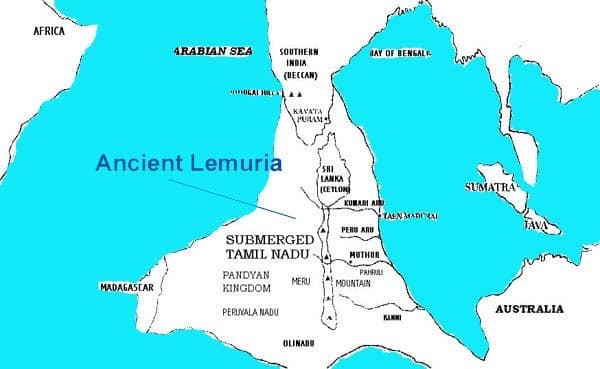
Hand-drawn map of the Indian Ocean region labeling the hypothetical lost continent of Ancient Lemuria
Key Takeaways
The history of partner-sharing and group sexuality is genuinely ancient, but the scholarship on pre-historic civilizations is deeply uneven and often mixes documented archaeology with legend.
Claims about pre-archaeological civilizations — Pangaea, Lemuria, Atlantis — belong to legend and esoteric tradition rather than to the historical record, and should be labeled as such when discussed.
Research summarized by the Kinsey Institute and mainstream anthropology supports the broad claim that diverse sexual configurations have existed across cultures, without supporting most specific historical detail about mythological civilizations.
Projecting modern consensual-non-monogamy ethics onto ancient or legendary civilizations risks both historical distortion and romanticized framing that flattens real cultural differences.
Frequently Asked Questions
Is consensual non-monogamy a recent invention?
No. Research summarized by the Kinsey Institute and mainstream anthropology indicates that diverse sexual configurations, including forms of partner-sharing and group sexuality, have existed across many documented cultures and historical periods. What is new is not the underlying human interest but the modern framework of explicit consent, mutual negotiation, and community accountability around it. The human pattern is ancient. The ethical infrastructure is recent.
What is the status of Lemuria, Atlantis, and similar legendary civilizations?
These belong to legend, myth, and esoteric tradition rather than to the archaeological record. Serious history does not treat them as documented civilizations with known practices. References to them in historical pieces should be clearly labeled as legend rather than presented alongside actual archaeology. Treating legendary civilizations as evidence for modern claims about sexuality is a category error that responsible writing avoids.
What does the archaeological record actually support about ancient sexuality?
The record supports considerably more than is sometimes acknowledged and considerably less than is sometimes claimed. Documented ancient civilizations — the Sumerians, Egyptians, Romans, and others — left artifacts and texts that reference diverse sexual practices, though the scholarly interpretation of specific practices varies. What the record cannot do is give precise quantitative or ritual detail about civilizations that left no evidence. Part two of this series treats the documented civilizations in detail.
The history of partner-sharing and group sexuality is genuinely ancient. That sentence is true, and it is the easy part. The harder part is being honest about what the historical record actually supports, what it does not, and where popular accounts of the "deep history" of consensual non-monogamy leave archaeology behind and enter the territory of legend, esoteric tradition, and wishful projection. This piece, the first in a three-part series, sets up the scholarly frame that the rest of the series will operate inside. The short version: there is good reason to take the ancient roots of non-monogamous sexuality seriously, and good reason not to inflate those roots with material that belongs to myth rather than to the record.
What the Scholarship Actually Supports
Research summarized by the Kinsey Institute, the Archives of Sexual Behavior, and mainstream anthropology supports a broad and defensible claim: diverse sexual configurations, including forms of partner-sharing and group sexuality, have existed across many documented cultures and historical periods. This is not a controversial position in the relevant fields. The human pattern — variation in how societies organize intimate and sexual relationships — is ancient.
What the scholarship does not support is most of the specific mythic detail that sometimes gets attached to this claim. Claims about 100-million-year-old civilizations, Pangaean humanoid paradises, Lemurian tribal cultures practicing normalized bisexuality, or Atlantean sexual-technology traditions do not come from archaeology. They come from nineteenth- and twentieth-century esoteric traditions, Theosophical writings, and speculative reconstructions that sit outside mainstream scholarship.
This matters because the interesting real history — which parts two and three of this series cover — is strong enough on its own. Sumerian artifacts, Egyptian texts, Roman literary and legal documentation: these constitute a real record that responsible history can draw on. Reaching past that record into legend flattens the genuinely interesting material and replaces it with claims the evidence cannot carry.
Legend, Myth, and the Limits of Projection
Pangaea, as a geological term, refers to the supercontinent that existed during the late Paleozoic and early Mesozoic eras, roughly 300 to 200 million years ago. Humans were not present; the continent's splitting predates our species by vast stretches of time. Pangaea as a paradise populated by sexually cooperative humanoids is an esoteric framing, not a scientific one, and it should be labeled as such in any historical discussion.
Lemuria was originally proposed in the nineteenth century as a hypothetical land bridge to explain lemur distribution patterns, then discarded as plate tectonics provided a better explanation. It was subsequently adopted by Theosophical and occultist writers as a spiritual civilization located in a variety of places and eras depending on the source. It has no archaeological existence.
Atlantis, as a legendary civilization, originates in Plato's dialogues Timaeus and Critias, where it functions as a moral-philosophical device. It is not a documented civilization. The many subsequent traditions that have grown up around Atlantis — crystal technology, sexual practices, flight, telekinesis — belong to esoteric literature rather than to archaeology.
Members who come to the lifestyle from an interest in its history often note the same thing: the real documented record is more interesting than the legendary one, and the temptation to reach for Atlantis or Lemuria usually comes at the cost of engaging seriously with the Sumerian, Egyptian, and Roman material that the scholarship actually supports. Honest history, community members suggest, is both more useful and more respectful of the people who lived and left evidence. Romanticized prehistory tends to flatten the actual humans involved.
— Lifestyle-active readers on Swing.com with an interest in the history and scholarship
Why the Scholarship Caveat Matters
The risk of projecting modern consensual-non-monogamy ethics onto ancient or legendary civilizations is twofold. First, it distorts the history. Ancient and prehistoric societies operated within social structures — slavery, rigid gender hierarchy, class stratification, violent enforcement of norms — that are structurally incompatible with how contemporary CNM describes itself. Calling ancient practices "the first swingers" in a modern ethical sense misreads both the ancient context and the modern framework.
Second, it substitutes romantic framing for evidence. The human interest in diverse sexual configurations does not need mythological civilizations to be real. It shows up in actual archaeology, actual texts, and actual cultural records from civilizations that left evidence. That record — complicated, uneven, but genuinely there — is enough.
What Comes Next in the Series
Part two of this series takes up the documented ancient civilizations in detail: Sumerian artifacts and their interpretation, Egyptian texts and ritual practice, Roman literary and legal documentation. Part three moves into the medieval, early modern, and modern periods where the record is denser but no less interesting. Each part stands alone. None of them depend on Pangaea, Lemuria, or Atlantis to make their case.
The history of non-monogamous human sexuality is ancient enough that it does not need legend added to it. The real record is the interesting one.
 Swing Editorial··4 min read