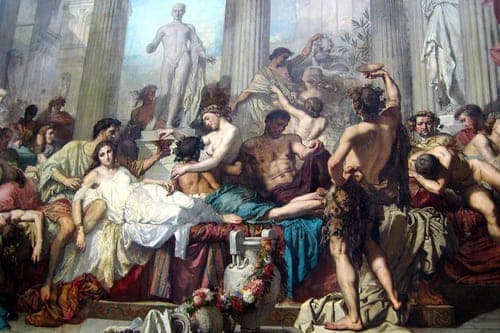
Classical painting of a Roman banquet with reclining figures in togas feasting among marble columns
Key Takeaways
The Sumerian Empire (8500–4500 BC) had remarkable sexual freedom, with men and women visiting others for casual sex and participating in orgies with strangers.
Ancient Egyptians used the blue lotus flower soaked in wine as an aphrodisiac before their group sexual gatherings.
Ancient Egyptian orgies were largely private affairs, while the Roman Empire made group sexual activity a more culturally known phenomenon.
The Roman Empire, despite its militaristic nature, was famous for its orgies and normalization of sex with multiple partners.
Historians show that the Romans were not the originators of orgies — earlier civilizations including the Sumerians and Egyptians had rich group sex traditions first.
Frequently Asked Questions
Did ancient civilizations practice swinging and group sex?
Yes — historical evidence shows that the Sumerians, Ancient Egyptians, and Romans all participated in forms of group sex and partner sharing. Sumerian statues depict orgies and casual sexual encounters, Egyptian culture used aphrodisiacs to enhance gatherings, and Roman orgies were so widespread they became culturally iconic. These practices long predated modern swinging.
What aphrodisiac did Ancient Egyptians use before orgies?
Ancient Egyptians soaked blue lotus of the Nile flower in wine before their sexual gatherings. The lotus contains alkaloids that, when combined with alcohol, produced an arousing effect. This was a deliberate preparation ritual used to heighten sexual desire and pleasure during group encounters.
When did sex with multiple partners become considered taboo?
According to historical analysis, sex with multiple partners became increasingly stigmatized as the Roman Empire rose and eventually declined. After centuries of relative openness in ancient civilizations, religious and state institutions began imposing monogamous norms. The Roman era marked a turning point where group sexuality gradually became culturally controversial in Western societies.
The modern lifestyle community often gets framed as a product of postwar American culture — suburban couples, key parties, the 1970s. That framing is not wrong exactly, but it is dramatically incomplete. The archaeological and historical record suggests that group sexuality and partner-sharing practices are considerably older than any specific cultural moment in the twentieth century, and that the impulse they reflect has surfaced repeatedly across very different civilizations.
A note on the scholarship: this article draws on broadly documented historical evidence for each civilization discussed. The historical record is uneven — considerably more is documented about Roman practices than Sumerian or Egyptian — and any account that claims precise numerical or ritual detail beyond what archaeology supports should be treated with skepticism. What follows is an honest summary of what the record suggests, not an embellished version designed to make the past sound more like the present than it was.
The Sumerian Civilization
The Sumerian civilization, which developed in Mesopotamia beginning around 8500 BCE and persisted in various forms until roughly 4500 BCE, is among the earliest complex urban societies for which sexual artifacts have survived. Sumerian statuary and relief carvings depict sexual acts involving multiple participants, and historical interpretation of these artifacts suggests that at least some forms of group sexual activity were practiced and depicted without apparent shame.
The Kinsey Institute has noted, in its broad documentation of the history of consensual non-monogamy, that evidence of partner-sharing practices predates the historical periods most Westerners associate with sexual history. The Sumerian record is part of that older evidence base. What the artifacts cannot tell us with confidence — and what responsible historical accounts should acknowledge — is the specific social context, consensual framework, or degree of voluntariness associated with the depicted practices. Interpreting ancient cultures through contemporary consent norms is an exercise that requires care.
What is documented is that the Sumerian civilization represented a form of social organization in which sexuality was depicted openly, in monumental and in domestic contexts, and that this openness appears to have been normative rather than transgressive within the culture.
Ancient Egypt
The Egyptian Empire, which sustained one of history's longest continuous civilizations from approximately 3150 BCE to 27 BCE, produced both explicit artistic depictions of group sexuality and documented references to aphrodisiac rituals associated with sexual gatherings. Among the substances referenced in surviving texts is the blue lotus of the Nile, a water plant whose alkaloid compounds, when processed and combined with alcohol, produced psychoactive and reportedly arousing effects.
The use of ritual preparation before group sexual gatherings — whether botanical, ceremonial, or both — suggests intentionality rather than simple opportunism. Egyptian culture appears to have treated at least some forms of group sexuality as deliberate, organized events rather than purely spontaneous encounters. The degree to which this was widespread versus restricted to particular social strata or ceremonial contexts is not fully resolved in the scholarship.
Egyptian sexual culture also existed alongside explicit power asymmetries — the institution of slavery, hierarchical gender relations, and the specific sexual politics of divine kingship — that complicate any simple reading of ancient sexual freedom as analogous to contemporary consensual practice.
Members who come to the lifestyle from an interest in its history often note that the modern community's emphasis on consent and explicit negotiation represents a meaningful departure from the historical record, not simply a continuation of it. Ancient practices, whatever their character, did not operate within a framework of mutual enthusiastic consent as contemporary practitioners understand it. What the history shows, members suggest, is that the human capacity for non-monogamous sexuality is genuinely ancient — but that the ethical framework around it has evolved substantially, and that evolution is something worth acknowledging rather than glossing over.
— Swing.com members with an interest in the historical and anthropological dimensions of the lifestyle
The Roman Empire
The Roman period, from the late Republic through the Imperial era (roughly 27 BCE onward), is the best-documented ancient civilization for what the historical record calls organized group sexuality. Roman sources — literary, satirical, and eventually legal — make clear that group sexual gatherings among wealthy Romans were sufficiently common to generate both celebration and condemnation. The Satyricon, the poetry of Catullus, and later moralizing texts from the Imperial period all reference these practices in ways that confirm their cultural visibility, if not their precise frequency.
The scholarly consensus, reflected in the work cited by the Kinsey Institute on the history of non-monogamous practice, is that the Romans did not invent group sexuality — the Sumerian and Egyptian evidence predates them significantly — but that they normalized and aestheticized it in ways that entered the Western cultural record more directly than their predecessors. Roman cultural products were transmitted to subsequent European civilization in ways that Sumerian clay tablets were not, which accounts for the persistent popular association of group sexuality with Rome specifically.
The Roman period also marks a relevant inflection point: the institutional rise of Christianity and the imposition of increasingly rigid monogamous norms that defined Western sexuality for the millennium and a half following. The shift from relative public openness to strict monogamous enforcement happened gradually over the late Imperial period and continued through the medieval era. What had been normative — or at least openly depicted — became forbidden, and then shameful, and then pathologized.
What This History Means for the Modern Lifestyle
Understanding that forms of group sexuality have existed across multiple ancient civilizations does not resolve contemporary questions about how consensual non-monogamy should be practiced. The historical record is a record of what was, not a guide to what is ethical. Ancient practices occurred within social structures — slavery, rigid gender hierarchy, class privilege — that practitioners in the modern lifestyle explicitly reject.
What the history does usefully establish is that the human interest in forms of non-monogamous sexual connection is not aberrant, recent, or culturally marginal. Research summarized by the Archives of Sexual Behavior on the long history of CNM practices finds that these relationship structures have appeared across cultures and historical periods consistently enough to constitute a stable human pattern rather than a particular era's deviation.
If the lifestyle community in 2026 is distinctive, it is not because it invented something unprecedented. It is because it has built, around a genuinely ancient human interest, a framework of explicit consent, mutual negotiation, and community accountability that earlier civilizations did not have and would likely not have recognized. That development is the modern contribution. Swing.com's event network, verified community, and platform infrastructure are expressions of it — an ancient human interest housed in a thoroughly contemporary ethical structure.
This article stands alone; it does not depend on any prior installment in a series, and the history it covers is complete as presented here.
 Swing Editorial··5 min read