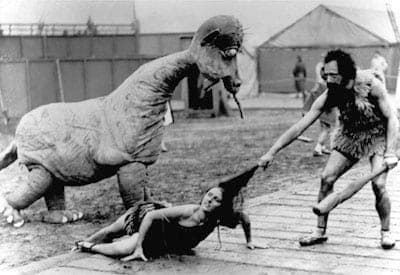
Vintage black-and-white film still of costumed cavemen and a dinosaur prop dragging a woman on a set
Key Takeaways
Evolutionary-anthropology arguments for non-monogamous early human behaviour are real hypotheses advanced by real researchers — but they remain contested rather than settled science.
Archaeological evidence about specific prehistoric sexual practices is fragmentary; interpretations often say more about the interpreter's era than about the evidence.
Nineteenth- and twentieth-century Western writing heavily exoticised non-European cultures' sexualities in ways that distorted the record.
The shift to settled agriculture is widely associated with stricter pair-bonding norms, but the exact causal story varies between researchers.
The modern lifestyle does not depend on ancient precedent for its legitimacy — the honest ground is consent, communication, and mutual enthusiasm in the present.
Frequently Asked Questions
Did prehistoric humans practice something like swinging?
The honest answer is "we don't know in detail, and anyone claiming otherwise is overstating the evidence." Evolutionary anthropologists including Hrdy, Ryan and Jethá, and Fisher have argued that early human sexual behaviour was probably more varied than strict monogamy, but those are competing hypotheses rather than settled findings. The archaeological record is fragmentary, and specific claims about prehistoric group sex or partner exchange are usually projection rather than documentation.
Is there good archaeological evidence for ancient sexual practices?
There is evidence — figurines, art, inscriptions, burial contexts — but the evidence is usually fragmentary and heavily mediated by the interpretive frame of whichever era is reading it. Nineteenth- and twentieth-century Western writers in particular tended to exoticise non-European cultures' sexualities in ways that exceeded the evidence. Contemporary scholarship is more cautious, which makes the cautious interpretation the honest one.
Did monogamy only appear with the rise of agriculture?
A common argument — associated with evolutionary anthropologists including Timothy Taylor and others — is that the shift from hunter-gatherer life to settled agriculture created conditions (fixed property, fixed households, inheritance) that favoured stricter pair-bonding norms. The argument is plausible and widely discussed, but it remains a hypothesis rather than a proven causal chain. Other researchers emphasise different factors.
The internet is full of confident stories about prehistoric swingers. Cavemen who partner-swapped. Hunter-gatherer societies that practised institutionalised group sex. Ancient civilisations whose ritual orgies set a precedent for today's lifestyle community. Some of these accounts cite real researchers and real findings; most of them considerably overstate what the evidence can support. For anyone curious about the actual scholarship, the honest story turns out to be both more uncertain and, arguably, more interesting than the cleaned-up popular version. This piece walks through what serious researchers have actually argued, where those arguments are contested, and why the lifestyle community does not need ancient precedent to make its case.
What Do the Evolutionary-Anthropology Arguments Actually Say?
The accurate version is that several evolutionary anthropologists have argued — across decades, in competing ways — that early human sexual behaviour was probably more varied than strict lifelong monogamy. Researchers like Sarah Blaffer Hrdy, Ryan and Jethá, and Helen Fisher have each framed different versions of the hypothesis. These are hypotheses, not settled findings, and they are genuinely contested inside the field. Evolutionary anthropology complicates the picture of humans as "naturally" monogamous, but it does not provide a clean documentary basis for claiming prehistoric humans practised swinging in the contemporary sense.
A recurring claim in popular accounts is that "science has proven" prehistoric humans were non-monogamous. The more accurate version is that several evolutionary anthropologists have argued — across decades, in competing ways — that early human sexual behaviour was probably more varied than strict lifelong monogamy. Those are hypotheses, not settled findings.
Researchers like Sarah Blaffer Hrdy have worked on the evolutionary biology of cooperative childrearing, arguing that early human mothers probably relied on support networks that extended beyond a single male partner. Ryan and Jethá are probably the most cited in lifestyle circles — their work framed a popular-audience version of the hypothesis that pre-agricultural humans lived in more sexually egalitarian bands. Anthropologist Helen Fisher has written extensively on the evolution of pair-bonding and serial monogamy, arguing that human pair-bonds are real but not necessarily exclusive or permanent.
These arguments exist. They are advanced by credentialed researchers. They are also genuinely contested inside the field — other evolutionary biologists and anthropologists have pushed back, pointing out that the evidence for any specific prehistoric sexual arrangement is weak, that contemporary hunter-gatherer societies vary enormously (and do not cleanly support any single narrative), and that projecting a specific sexual politics backward onto the Pleistocene tends to reflect the projector's era more than the evidence.
The honest summary for a lifestyle reader: evolutionary anthropology offers interesting hypotheses that complicate the picture of humans as "naturally" monogamous, but it does not provide a clean documentary basis for claiming that prehistoric humans practised swinging in anything like the contemporary sense.
Why Is the Archaeological Record on Ancient Sexuality Harder Than It Looks?
Ancient societies produced art, figurines, inscriptions, and burial contexts that seem to bear on sexuality, but the interpretation of those artefacts is heavily shaped by the interpreter's era. A fertility figurine might be read as evidence of ritual sexuality, of ritual symbolism without sexual practice, of mundane decorative intent, or something else entirely — the primary sources rarely settle the question, while the interpretive frames do. Historical CNM scholarship has cautioned against reading modern sexual frameworks backward onto ancient evidence, a practice that produces interpretations shaped more by the reader's expectations than the record.
The archaeological evidence presents its own problems. Ancient societies produced art, figurines, inscriptions, and burial contexts that seem to bear on sexuality, but the interpretation of those artefacts is heavily shaped by the interpreter's era. A fertility figurine might be read as evidence of ritual sexuality, evidence of ritual symbolism without sexual practice, evidence of mundane decorative intent, or something else entirely. The primary sources rarely settle the question; the interpretive frames do.
Research summarised by the Archives of Sexual Behavior on historical CNM scholarship has consistently cautioned against reading modern sexual frameworks backward onto ancient evidence — a practice that tends to produce interpretations shaped more by the reader's expectations than by the historical record itself. The same caution applies to prehistory, where the evidence is still thinner and the interpretive distance even greater.
What Is the Nineteenth- and Twentieth-Century Exoticisation Problem?
A large portion of popular "ancient sexuality" writing descends not from primary evidence but from nineteenth- and twentieth-century Western writers who were simultaneously fascinated by and condescending toward other cultures. Colonial-era European accounts of African, Asian, Polynesian, and Indigenous sexuality were heavily exoticised — projected through fantasies of liberation, primitivism, or decadence that said far more about the writers' societies than the cultures being described. Much of what still circulates online as "evidence" of prehistoric non-monogamy traces back to this strand, often through layers of repetition.
One of the most important things to understand about popular "ancient sexuality" writing is that a large portion of it descends not from primary evidence but from nineteenth- and twentieth-century Western writers who were simultaneously fascinated by and condescending toward other cultures. Colonial-era European accounts of African, Asian, Polynesian, and Indigenous sexuality were heavily exoticised — projected through fantasies of liberation, primitivism, or decadence that said far more about the writers' own societies than about the cultures being described.
Much of what still circulates in online lifestyle writing as "evidence" of prehistoric or ancient non-monogamy traces back to this strand of writing, either directly or through several layers of repetition. Contemporary anthropologists working with the same source material are generally much more cautious, both about specific claims and about the ethics of generalising from fragmentary evidence about cultures with their own complex internal diversity.
The result is a genuinely difficult epistemic situation. Some of the prehistoric-sexuality claims that feel well-supported online are well-supported only in the sense that they have been repeated for a long time. Going back to the primary scholarship — and to researchers who work carefully with it — tends to produce a much more qualified picture.
What Does the Agriculture-and-Monogamy Hypothesis Argue?
One of the more durable arguments holds that the shift from hunter-gatherer life to settled agriculture created conditions that favoured stricter pair-bonding norms. Fixed property, fixed households, and inheritance chains all provide practical reasons for a tighter association between a specific man, a specific woman, and their specific children. Versions of this argument have been advanced by anthropologists including Timothy Taylor. The argument is plausible and widely discussed, but it is not a proven causal chain — other researchers emphasise different factors that complicate any single-factor explanation.
One of the more durable arguments in this space holds that the shift from hunter-gatherer life to settled agriculture created conditions that favoured stricter pair-bonding norms. Fixed property, fixed households, and inheritance chains all provide practical reasons for a tighter association between a specific man, a specific woman, and their specific children. Versions of this argument have been advanced by anthropologists including Timothy Taylor, and it shows up in a range of popular and academic accounts of sexual history.
The argument is plausible and widely discussed. It is also not a proven causal chain. Other researchers have emphasised different factors — disease ecology, shifts in food availability, the specific politics of particular agricultural societies — that complicate any single-factor explanation. As with the deeper-time arguments, the honest framing is: a real hypothesis, advanced by real researchers, remaining under genuine debate.
A recurring conversation in the lifestyle community is how much of the appeal of "ancient precedent" is validation-seeking — a desire to demonstrate that consensual non-monogamy is natural, original, and therefore legitimate. Longer-term members tend to arrive at the same place: the community does not need ancient precedent to be legitimate. It is legitimate because the couples and singles inside it practise it consensually, communicate carefully, and treat each other well. The specific details of what prehistoric humans may or may not have done are interesting as scholarship, but they are not load-bearing for the modern lifestyle's case for itself. That case is made, and remade, in the present.
— Long-time Swing.com members we've spoken with
What Is Genuinely Well-Supported About Human Sexual History?
A few general claims about human sexual history can be stated with reasonable confidence even when the specifics remain uncertain. Humans have, across many cultures and eras, constructed ritual, celebratory, or consensual contexts in which group or extra-dyadic sexual activity occurred. Strict universal monogamy is not the documented norm across all human societies — a range of arrangements appears across the record. What is not supported is the confident claim that any specific prehistoric arrangement — institutionalised group sex, systematic partner swapping — can be read directly off the archaeological record.
Stepping back, a few general claims about human sexual history can be stated with reasonable confidence even when the specifics stay uncertain.
Humans have, across many cultures and eras, constructed ritual, celebratory, or consensual contexts in which group or extra-dyadic sexual activity occurred. The Kinsey Institute and the broader anthropological literature support this at a general level. Strict, universal monogamy is not the documented norm across all human societies — a range of arrangements appears across the record, including polygyny, polyandry, socially sanctioned extramarital sexuality, and various forms of what a contemporary reader might recognise as consensual non-monogamy.
What is not supported is the confident claim that any specific prehistoric arrangement — institutionalised group sex, systematic partner swapping, a "naturally" non-monogamous humanity — can be read directly off the archaeological record. The record is too fragmentary, the interpretive history too compromised, and the human variability too real to let any single story settle.
Is the Modern Lifestyle Community an Heir or a Descendant of Ancient Practice?
The most intellectually honest framing is that the modern consensual non-monogamy community inherits a long human tradition of curiosity about and experimentation with non-dyadic sexual arrangements — but that inheritance is broad rather than specific. It is general human curiosity across cultures, not a documented lineage descending from any particular prehistoric practice. The contemporary lifestyle is something its own members are building, right now, on the foundations of consent, communication, and mutual enthusiasm. The history matters as context, not as credential.
The most intellectually honest framing for lifestyle-curious readers is this. The modern consensual non-monogamy community inherits a long human tradition of curiosity about and experimentation with non-dyadic sexual arrangements. That inheritance is real, and it is broad rather than specific — general human curiosity across cultures, not a documented lineage descending from any particular prehistoric practice.
The contemporary lifestyle is something its own members are building, right now, on the foundations of consent, communication, and mutual enthusiasm. Platforms like Swing.com exist because that building is happening — profiles, events, community forums, verified member lists, and group messaging all support the specific, modern, digital-era practice of consensual non-monogamy. The history matters as context, not as credential.
How Should Lifestyle Readers Approach Ancient Sexuality Without Overclaiming?
Ancient and prehistoric sexuality remains a genuinely fascinating field of scholarship precisely because it is so uncertain. The honest story — fragmentary evidence, contested hypotheses, heavy interpretive mediation — is more intellectually interesting than the confident version that still circulates in popular lifestyle writing. Treating the scholarship with care means allowing that the specifics may never be settled. For lifestyle members who want to read further, the reliable approach is to go to primary scholarship in peer-reviewed journals and institutions like the Kinsey Institute rather than popular accounts.
Ancient and prehistoric sexuality remains a genuinely fascinating field of scholarship precisely because it is so uncertain. The honest story — fragmentary evidence, contested hypotheses, heavy interpretive mediation — is more intellectually interesting than the confident version that still circulates in popular lifestyle writing. Treating the scholarship with care means allowing that the specifics may never be settled, and that the general claim of widespread human sexual variability across history stands up on its own without needing to be dressed in specific unsupported details.
For lifestyle members on Swing.com who want to read further, the most reliable approach is to go to the primary scholarship — researchers working in peer-reviewed journals, institutions like the Kinsey Institute — rather than to popular accounts that repeat each other. The picture that emerges is less tidy than the online version, but tidiness is not what good scholarship delivers. What it delivers is honesty, and in a community that is itself built on honesty, that is the version worth having.
 Swing Editorial··6 min read