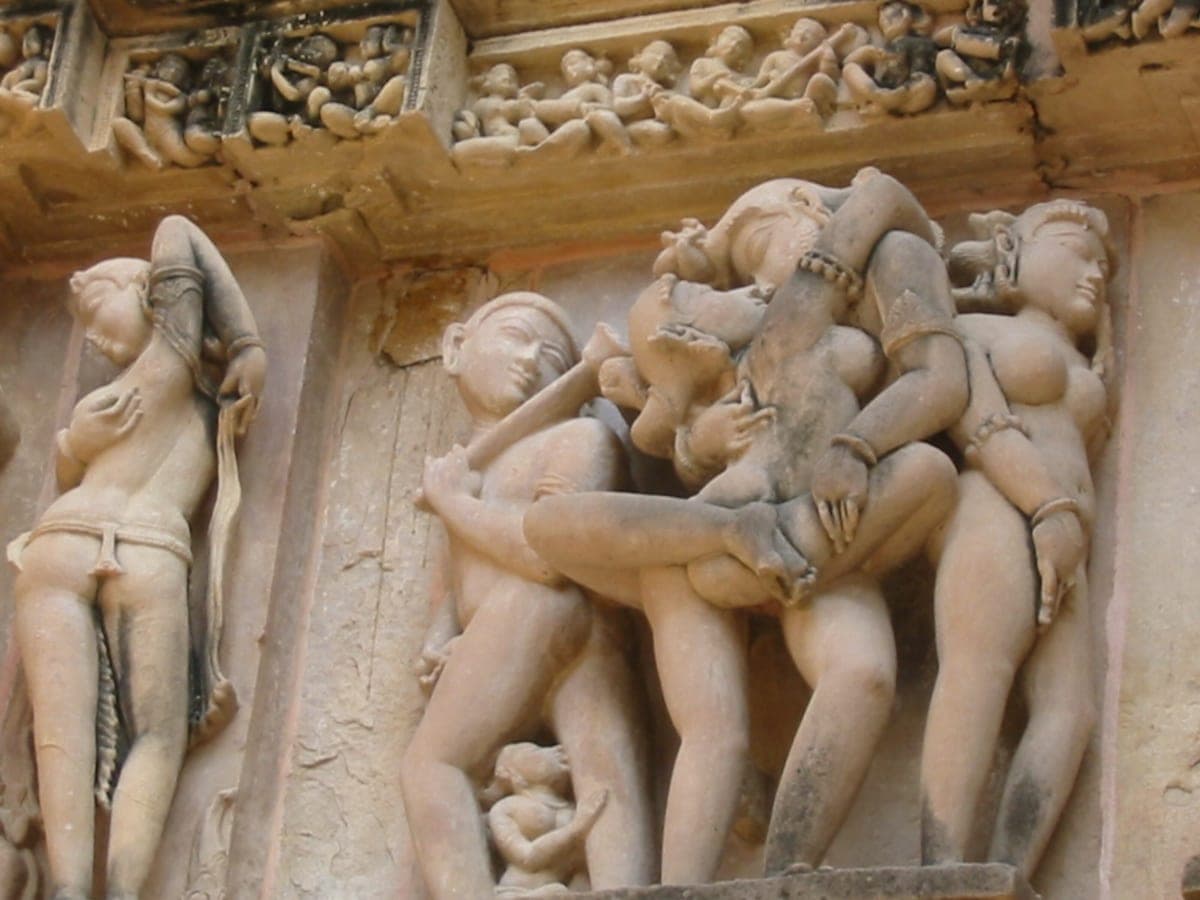
Weathered stone temple carvings of intertwined nude figures in intimate poses, Khajuraho-style relief
Key Takeaways
Historical attitudes toward sex varied widely across cultures, and surviving sources describe a range of practices that modern readers would recognize as more permissive than later Western norms.
The surviving record is uneven. Much of what is known comes from religious, literary, and elite-class sources. Everyday sexual practice is less well-documented than those sources suggest.
Projecting modern categories — "swinging," "polyamory," "open relationships" — backward onto ancient practices distorts both the historical record and the present-day lifestyle.
The rise of sexual restriction as a dominant Western norm is generally associated by historians with the spread of organized religion and changing political structures, though the process was gradual and varied by region.
Frequently Asked Questions
Did ancient civilizations practice consensual non-monogamy in a modern sense?
The honest answer is that the record does not cleanly support that framing. Ancient cultures left evidence of a wider range of sexual expression than later Western norms allowed, but "consensual non- monogamy" as practiced today — with its emphasis on negotiated agreements between adults, verified consent, and a specific ethical framework — is a modern formation. Some ancient practices look superficially like antecedents; careful historians generally resist calling them ancestors of the modern lifestyle.
What does the historical record genuinely show about sex across cultures?
It shows substantial variation. Some cultures and periods celebrated sexual expression in religious, social, and literary contexts with fewer restrictions than later Western norms. Other cultures in the same era were highly restrictive. Within a single culture, attitudes often differed sharply across social classes and genders. Researchers describe the variation; they tend to resist flat generalizations that treat any one ancient culture as universally sexually liberated.
Why is it risky to claim specific ancient practices as lifestyle ancestors?
Two reasons. First, the surviving record is fragmentary and disproportionately preserves elite, male, and religious perspectives; everyday practice is much less well-documented. Second, modern consensual non-monogamy developed from specific twentieth- and twenty-first-century social conditions — negotiated agreements, explicit consent frameworks, verified communication tools. Treating it as an unbroken thread from antiquity overstates what the evidence actually supports and obscures the distinctive ethics of the modern community.
The history of human sexuality is one of the most persistently miswritten subjects in popular culture, and the reason is worth naming at the start. The record is uneven enough that almost any claim can be supported by a carefully selected fragment, and popular histories routinely do exactly that — assembling a narrative of ancient sexual liberation followed by religious repression that serves a modern argument more than it reflects what historians actually say. A careful overview of sex across history has to do two things at once: describe what the record genuinely supports, and name the limits of that record clearly. Both matter.
What the Record Genuinely Supports
Across a range of ancient civilizations — Mesopotamian, Egyptian, Greek, Roman, and others — surviving sources describe attitudes toward sexual expression that were, in broad strokes, less restrictive than the later Western norms inherited through organized religion. Sexual themes appear in religious practice, literary culture, and public art in forms that later eras would find unacceptable. Researchers working on the ancient Mediterranean describe sexual practice as integrated into religious and civic life in ways that do not map cleanly onto later distinctions between sacred and profane. The Greek word "orgia" carried meanings tied to religious rite, and only later — through a long process of linguistic and cultural drift — settled into its modern English sense.
Outside the Mediterranean, the record shows similar variation. South Asian textual traditions preserved the Kama Sutra and related texts as part of a broader literature on worldly life and pleasure. East Asian traditions produced their own literatures on sexual practice integrated with medical, philosophical, and social thought. What these examples share is not a uniform permissiveness but a documented variation — evidence that the specific configuration of sexual restriction that came to dominate later Western culture was one of several possible settlements, not a universal human norm.
The Limits of What the Record Supports
The qualifications matter at least as much as the broad strokes. Much of the surviving evidence comes from religious, literary, and elite-class sources, which preserve a particular slice of experience. Everyday sexual practice across the ancient world is far less well-documented than the richer material from temples, courts, and literary elites suggests. Gender disparities in the record are significant — most surviving sources reflect male perspectives, and women's experience across these cultures is substantially underrepresented.
Within any given ancient culture, attitudes varied sharply across class, gender, and region. The Rome of Augustan moral legislation was not the Rome of imperial-period satire; the Greek polis ideal was not the lived experience of enslaved people within it. Flat generalizations that treat any one ancient culture as uniformly sexually liberated tend to collapse real internal variation into a flat caricature. Careful historians resist those flattenings, and popular histories that indulge them are doing something different from history.
The Rise of Sexual Restriction
The shift toward the restrictive norms that dominated later Western culture was gradual and multi-causal. Historians generally associate it with the spread of organized religion — particularly Christianity, and later Islamic and other religious systems — alongside changing political, economic, and family structures. Fixed agricultural household arrangements, inheritance systems that depended on confirmed paternity, and the consolidation of religious authority all contributed. The process was not a single rupture; different regions shifted on different timelines, and pockets of continuity with earlier norms persisted for centuries.
Describing this shift does not require romanticizing the earlier period. The cultures that preceded the restrictive turn had their own forms of coercion, their own gender hierarchies, and their own exclusions. The honest frame is that the specific configuration of sexual restriction Western modernity inherited is one possible settlement among many, not an inevitable one — and that recognizing this does not require claiming any earlier settlement was better in all respects.
Members describe a consistent hesitation about popular histories that claim the lifestyle is "ancient" or "the natural human state." The framing feels forced — and reading it carefully often shows the same handful of fragments being repurposed across many sources. The reaction members tend to prefer is more grounded: the historical record shows that sexual restriction is not a universal human default, and that alone is enough. Claiming a specific lineage from any particular ancient civilization to the modern lifestyle is both weaker history and worse advocacy.
— Swing.com members who have discussed how lifestyle participants talk about history
Why Projecting Modern Frames Backward Matters
Consensual non-monogamy as practiced today — with its emphasis on explicitly negotiated agreements, verified consent, specific ethical frameworks around communication and limits, and platforms that make those negotiations possible — is a modern formation. It grew out of specific twentieth- and twenty-first-century conditions: changing gender relations, contraceptive technology, second-wave and later feminist thought, an online infrastructure for finding community, and a specific ethical language developed largely in the last several decades.
Treating ancient practices as direct ancestors of the modern lifestyle flattens the difference between what historians can document about the ancient world and what distinguishes the present-day community. The ethics of the current lifestyle — enthusiastic consent, explicit communication, limit-setting, aftercare — are not attributes of every historical arrangement that allowed multiple partners. They are attributes of a specific modern movement. A reader who wants to understand the lifestyle is better served by understanding that movement on its own terms than by reaching for a fabricated ancestral pedigree that does not hold up to careful historical scrutiny.
 Swing Editorial··4 min read