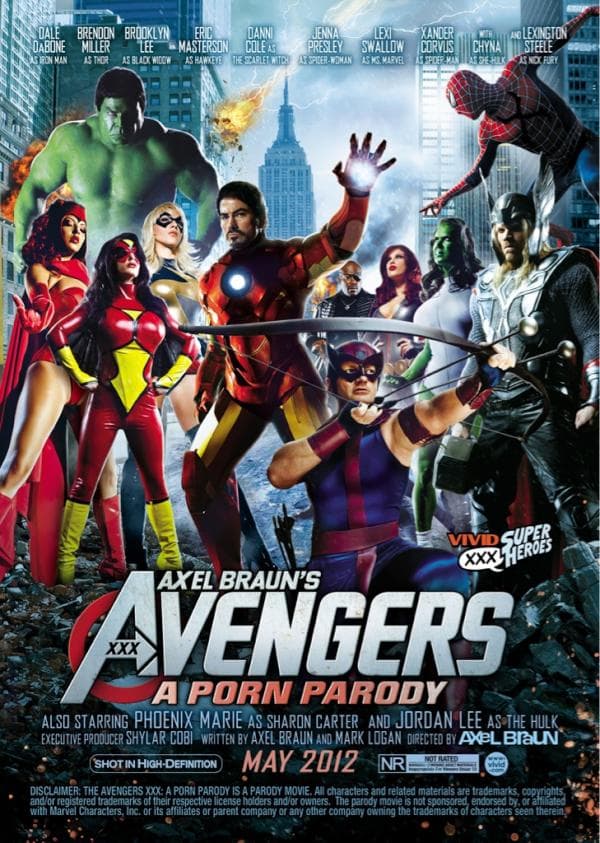
Movie poster for Axel Braun's Avengers XXX A Porn Parody showing cosplay superheroes arrayed in front of a city skyline
Key Takeaways
Adult film director Axel Braun created an Avengers XXX parody that mirrors the plot and production values of the blockbuster while featuring Marvel superheroes in orgy scenarios.
Unlike the official film which had licensing restrictions preventing Spider-Man's inclusion, the parody includes Spider-Man, She-Hulk, and the full Marvel roster.
The author recommends Avengers XXX as great entertainment to watch at swinger parties, alongside other pop-culture porn parodies like Ghostbusters and Star Wars.
Frequently Asked Questions
What is the Avengers XXX parody?
Avengers XXX is an adult film parody of the Marvel Avengers franchise directed by Axel Braun. Unlike the official film which had licensing restrictions, the parody features the full superhero roster including Iron Man, Black Widow, Nick Fury, Hawkeye, Thor, Spider-Man, She-Hulk played by Chyna, and others. The cast engages in orgy-style scenarios, and the production is praised for attempting to replicate the plot structure and visual quality of the blockbuster.
What adult parody movies are good to watch at swinger parties?
The article recommends Avengers XXX alongside other pop-culture porn parodies including a Ghostbusters parody, a Star Wars parody, and a dual Avatar and Simpsons parody. These films are described as entertaining and conversation-starting options for lifestyle parties where couples want shared adult entertainment with a humorous or familiar pop-culture angle.
Who made the Avengers XXX adult parody?
Axel Braun, a well-regarded adult film director known for high-production-value parodies of mainstream films, created Avengers XXX. The author calls Braun one of his favorite adult filmmakers and praises the production's ambition and casting. The film is positioned as a genuinely watchable parody rather than a low-effort cash-in.
Ask anyone who has been to a well-run cosplay or themed lifestyle party and they tend to describe the same phenomenon: the social energy was different. People talked more easily. Guests who might normally spend the first hour near the drink table instead found themselves in conversations within minutes. The theme did that work.
Fantasy and character themes have been part of lifestyle party culture for decades, and their staying power is not accidental. This piece looks at why themed events succeed, who they work best for, and what couples and hosts can do to make the format genuinely inclusive.
Why Themes and Costumes Work at Lifestyle Events
The social challenge at any lifestyle event is identical to the social challenge at any party where guests do not all know each other: the first conversation is the hardest. Costumes solve that problem almost automatically. When every guest arrives dressed as a character or archetype, every interaction begins with a ready-made opening — what the costume is, who chose it, how it was assembled, whether the other person almost wore the same thing. That shared visual reference collapses the distance between strangers faster than any other device.
Themes also provide identity cover, which matters meaningfully for lifestyle participants who value discretion. A mask or character costume creates a layer of separation between a guest's everyday public identity and their presence at the event. This is not evasion — it is a genuine feature that draws members who would otherwise hesitate to attend a lifestyle gathering.
Superhero and iconic fictional-character themes are among the most popular in the community precisely because the reference points are universal. Characters like Captain America or Black Widow are recognizable to essentially every adult, can be assembled into a costume at almost any budget, and work equally well for couples, solo guests, same-sex pairs, non-binary members, and anyone approaching the theme creatively. The costume options in a broad character universe are large enough that every guest can find a fit without defaulting to narrow gender expressions.
Making Themed Events Inclusive by Design
A cosplay event built only for heterosexual couples in traditional gender configurations is leaving a significant portion of the lifestyle community on the outside. The themed events that generate the strongest positive word of mouth are those built with every configuration in mind from the planning stage.
That means: naming explicitly in the event listing that same-sex couples, solo members, non-binary guests, mixed-orientation configurations, and creative gender-swapped costume takes are not just tolerated but actively welcomed. It means selecting themes broad enough that the character roster offers real choices — not just two or three default pairings. It means building the physical space and the social norms of the evening to match that promise.
Non-binary and gender-swapped costume choices are not uncommon at experienced lifestyle cosplay events. They are routinely celebrated. A guest who shows up as a gender-swapped version of a recognized character is engaging creatively with the theme, and hosts who understand their community honor that engagement.
The best themed nights we have been to were the ones where the event listing made it clear: all genders, all configurations, all costume interpretations are welcome. When that language is in the listing, the room reflects it. You get a same-sex couple in matching villain costumes next to a throuple in coordinated gear next to a solo woman who put together the most creative interpretation of the theme anyone had seen. That diversity of representation makes the event feel real rather than performative.
— Cosplay-event regulars on Swing.com we've heard from
Consent and Costumes
One point that experienced cosplay-event participants raise consistently: a costume does not change the consent rules. What it changes is the social warmth of the room — not the standard of explicit, enthusiastic agreement that applies to every other dimension of lifestyle participation.
This includes the costume itself. Reaching for someone's prop, cape, or accessory without asking is contact without consent. Costumes that involve elaborate handwork deserve acknowledgment as creative effort, not just as aesthetic features. The line between "I love your costume" as genuine appreciation and "I love your costume" as a lead-in to unwanted physical contact is one that hosts should address explicitly at the start of any cosplay event.
Opt-in signaling systems — a designated wristband color, a specific accessory guests can choose to add to indicate openness to interaction — work well in cosplay contexts because they integrate naturally with the costume framework. Hosts who explain the system clearly and model it consistently tend to report the best outcomes.
Finding and Hosting Themed Lifestyle Events
Swing.com's event calendar includes themed and cosplay lifestyle events across major markets. Searching by city and filtering by event type surfaces current listings from verified hosts and established event series. Reading the host profile and event history before RSVPing gives you a clear picture of who is running the evening and what to expect.
For couples considering hosting their own cosplay event, the planning sequence that works most reliably is: choose a theme with enough breadth that every guest can participate, name inclusivity explicitly in the listing, plan a social hour before play begins, and build in a clear start-of-evening explanation of house rules including the consent norms specific to cosplay contexts.
The format rewards the investment. Themed nights that are planned thoughtfully tend to become the events guests mention when they are asked what they remember most from a season in the scene.
 Swing Editorial··4 min read