Swing Logo
  • Blog
  • Lifestyle
  • Swinger Couples
  • Couple Swapping
  • Clubs
  • Threesomes
  • Hotwifing
  • Cuckold
  • BDSM
  • Open Relationships

This site does not contain sexually explicit images as defined in 18 U.S.C. 2256. Accordingly, neither this site nor the contents contained herein are covered by the record-keeping provisions of 18 USC 2257(a)-(c).

Disclaimer: This website contains adult material. You must be over 18 to enter or 21 where applicable by law. All Members are over 18 years of age.

Events|Podcast|Blog|About|FAQ

Terms of Use|Privacy Policy|FOSTA Compliance Policy

Copyright © 2001-2026

DashBoardHosting, LLC. All Rights Reserved.

  1. Home
  2. ›Blog
  3. ›Bisexual Swingers
  4. ›Bisexuality in the Lifestyle: What Research Supports

Bisexuality in the Lifestyle: What Research Supports

Swing EditorialSwing Editorial·Published September 21, 2011·3 min read

Bisexual Swingers

TL;DR

Research on bisexuality from institutions including the Kinsey Institute and the Archives of Sexual Behavior indicates that bisexual identification and behavior have grown in visibility, particularly among younger adults, and that bisexual participation within consensual non-monogamy is substantial. The lifestyle community has historically treated female-female play as normative while treating male-male interest as taboo — a well-documented bi-erasure pattern that is slowly changing. Institution-level researchers describe the treatment gap as structural, not inherent.
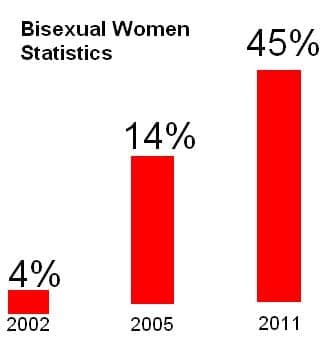
Red bar chart titled Bisexual Women Statistics showing 4% in 2002, 14% in 2005, 45% in 2011

Key Takeaways

  • Research summarized by the Kinsey Institute and the Archives of Sexual Behavior indicates that bisexual identification and behavior have grown in visibility, particularly among younger adults, over the past two decades.
  • The lifestyle community has historically treated female-female play as normative while treating male-male interest as taboo — a well-documented bi-erasure pattern that research has named explicitly.
  • Bisexual-identified men often report a narrower range of welcome experiences within the lifestyle than bisexual-identified women, and the community is slowly addressing this structural gap.
  • Single bisexual women, sometimes called "unicorns" in community shorthand, have specific experiences worth honoring rather than romanticizing — including both genuine welcome and the pressure of being treated as rare resources.

Frequently Asked Questions

Has bisexual identification grown in recent decades?
Yes. Research summarized by the Kinsey Institute, the Archives of Sexual Behavior, and large-scale public surveys indicates that self-reported bisexual identification and behavior have grown in visibility over the past two decades, particularly among younger adults. Much of this growth is understood as reflecting reduced stigma and increased willingness to identify openly rather than a change in underlying attraction patterns. Specific percentage claims vary significantly across studies and populations; institution-level qualitative framing is more reliable than any single figure.
Why does the lifestyle community treat female-female and male-male differently?
The pattern is a well-documented cultural inheritance rather than anything inherent to consensual non-monogamy. Female-female play has been normalized and even expected at many lifestyle events, while male-male interest has historically been treated as taboo or prohibited. The pattern is structural bi-erasure of men and it shows up in research on CNM communities, not just in community commentary. The pattern is slowly changing, especially at explicitly inclusive events, but it remains uneven across regions and venues.
What is a "unicorn" in lifestyle shorthand, and is the term helpful?
A "unicorn" is community shorthand for a single bisexual or bi-curious woman interested in joining couples. The term is ambiguous: some women who identify this way use it comfortably, while others find it reductive and prefer to be referred to as people rather than as rare resources. The community has grown more aware of the tension. Using the word when someone uses it of themselves is fine; projecting it onto every single woman in a lifestyle space is generally not.

Related articles

  • Bisexual Women and the Swinger CommunityApr 10, 2014
  • Bisexual Swingers: Identity, Attraction, and What It MeansNov 24, 2014
  • Bisexual Swingers: Inclusion and the Bi Treatment GapAug 1, 2012

Bisexuality and consensual non-monogamy intersect in the lifestyle community in ways that are specific, uneven, and worth describing carefully. Popular coverage tends to reach for dramatic framings — surveys that "shock," percentages that supposedly tripled overnight — that do not hold up against the actual institution-level research. What the research does support is more interesting than the headlines: bisexual visibility has genuinely grown, bisexual participation within CNM is substantial, and the community itself still carries a well-documented asymmetry between how it treats bisexual women and bisexual men that is only slowly closing.

What the Research Actually Indicates

Research summarized by the Kinsey Institute, the Archives of Sexual Behavior, and large-scale population surveys indicates that self-reported bisexual identification and behavior have grown in visibility over the past two decades, particularly among younger adults. Much of that growth reflects reduced stigma and a greater willingness to identify openly rather than any dramatic shift in underlying attraction patterns.

Specific percentage claims vary considerably depending on how questions are asked, which population is sampled, and how the study defines "bisexual experience." Figures cited in one study rarely match figures in another. The responsible framing is institution-level and qualitative: bisexual visibility is meaningfully higher than it was a generation ago, bisexual participation in consensual non-monogamy is substantial, and the underlying orientation is understood to be stable across the research literature. Any piece that leads with a single dramatic percentage is usually citing a specific study out of context.

The Bi-Erasure Gap the Community Still Carries

The more durable observation about bisexuality within the lifestyle is a structural asymmetry. Female-female play has historically been normalized and even expected at many lifestyle events. Male-male interest has historically been treated as taboo, prohibited, or confined to separate spaces. This pattern is not inherent to consensual non-monogamy — it is a cultural inheritance from broader norms around masculinity and male sexuality — but it shows up consistently enough in research on CNM communities that it has been named explicitly as bi-erasure of men.

Bisexual-identified men in the lifestyle report a narrower range of welcome experiences than bisexual-identified women do. The difference is not small. Some men hide bisexual interest within the community they otherwise belong to. Others find their way to explicitly inclusive events or to smaller circles where the norm is different. The gap is closing — slowly, unevenly, and more at progressive-leaning events than at traditional ones — but it has not closed.

Bisexual women in the community often describe an experience that is both more welcomed and more projected-onto than they expected. The welcome is genuine; the projection — being treated as a rare resource, as something couples are hunting for, as "the unicorn" rather than as a person — is not. Bisexual men describe a different gap: real warmth from some members and events, explicit exclusion from others. What both groups share, community members note, is a preference for being asked who they are rather than sorted into a category on arrival.

— Lifestyle-active bisexual and bi-curious members on Swing.com

The "Unicorn" Label and What It Flattens

Community shorthand for a single bisexual or bi-curious woman interested in joining couples is "unicorn." The term is ambiguous. Some women who identify this way use it comfortably and find it useful. Others find it reductive and prefer not to be referred to as a rare resource. The tension is real and has grown more visible as the community has become more articulate about how labels shape experience.

The practical guidance that holds up well is straightforward: use the word when someone uses it of themselves, do not project it onto every single woman in a lifestyle space, and be willing to hear that some people have a complicated relationship with the label. A community that is honest about the mismatch between its shorthand and the people it is describing tends to do better by those people.

What Closing the Gap Looks Like

The treatment gap between bisexual women and bisexual men within the lifestyle is a structural issue, not an inherent one, which means it is closeable. Explicitly inclusive events, clear community messaging about MM welcome, language in venue policies that names bisexual men as belonging, and visibility for couples and configurations where bisexual men are full participants all move the needle. Research on CNM from the post-2020 cohort consistently frames inclusion as something communities build rather than inherit. The lifestyle community is in the middle of that work, and the pace of it has picked up noticeably in recent years.