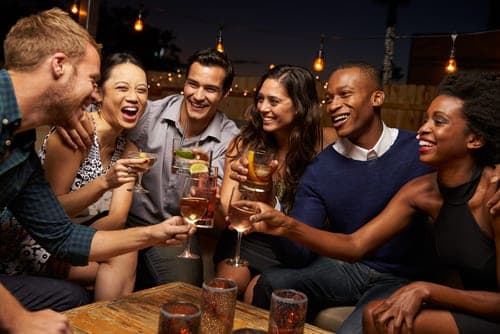
Six friends laughing and raising cocktail glasses around an outdoor table under warm string lights at night
Key Takeaways
Key parties, where partners are matched by drawing keys, are a fun and nostalgic way to add spontaneity to a swinger gathering.
Masquerade-style parties with costumes and masks create perceived anonymity that encourages guests to explore more freely.
Incorporating food play adds a playful, creative element to swinger parties without expensive equipment or advanced planning.
Group sex scenarios work best when there is a dedicated optional space so participants can choose to join without feeling pressured.
Great swinger parties don't require big budgets — creativity and an open mind are the most important ingredients.
Frequently Asked Questions
What are some fun ideas for a swinger lifestyle party?
Popular ideas include key parties where fate selects partners, Eyes Wide Shut-style masquerade parties with costumes and masks, food play with sensual ingredients from the kitchen, and group scenarios in a designated optional playroom. The best parties balance structured activities with the freedom for guests to participate at their own comfort level.
How do you keep a swinger party inclusive and pressure-free?
Setting clear expectations in the invitation and creating optional participation spaces ensures guests never feel coerced. Provide a dedicated playroom for those who want to participate in group activities while keeping social areas available for those who prefer to socialize. Communicating rules and boundaries before the event helps everyone feel safe.
Are swinger parties expensive to host?
Not necessarily. Many memorable lifestyle parties are hosted at private homes with minimal investment. Creative themes, DIY costumes, and simple food play can elevate the experience without significant expense. What matters most is the atmosphere, the guest list, and the mutual comfort and openness of everyone attending.
The best lifestyle parties hosts talk about afterward share an unusual quality: almost nothing felt choreographed, but everything that happened was genuinely chosen. That combination — spontaneity within a consent-positive structure — does not happen by accident. It is the result of a host who thought carefully about pacing, participation options, and how easy it is for any guest to enjoy the evening without feeling pushed toward anything.
This is the host-level view: how to design a party where the activities are inviting, the social structure protects everyone, and guests leave feeling like they made their own choices all night.
The No-One-Must-Play Rule
Before any activity idea: the most important decision a host makes is structural, not creative. Every guest should be able to attend, enjoy themselves, and leave without having participated in any sexual activity — and without that being treated as failure, awkwardness, or waste. The social and sensual spaces of the party should be genuinely separate, with movement between them entirely optional.
This rule protects everyone, including the guests who do participate. When participation is genuinely optional, the people who choose it are there because they actually want to be. That changes the quality of the interaction significantly.
Setting this expectation explicitly in the invitation — not as a disclaimer but as a genuine feature of the event — also tends to attract the right guests: people who understand that no is a complete answer and who are more likely to say yes genuinely when they do.
Ice-Breaker Frameworks That Actually Work
Hard-limit cards. A host can offer guests small cards during arrival where each person or couple writes their hard limits for the evening in their own words. The cards stay private — the exercise is to help each person articulate their own limits clearly to themselves, not to circulate as a checklist. The ritual of writing it down tends to make those limits more present in participants' minds throughout the evening.
Open preference conversations. Rather than pairing guests in advance, some hosts create a structured social period early in the evening where couples and individuals talk openly about what kind of connection they are looking for that night. Soft swap only, or open to full swap? Same-room or separate? Interested in group dynamics or prefer one-on-one? These conversations surface compatibility before anyone is invested in a particular pairing.
Activity Ideas With Built-In Pacing
The key party revisited. The classic key-party format — keys in a bowl, draw a key, find the owner — remains genuinely popular for the reason it always was: it introduces an element of fate that sidesteps the social awkwardness of direct selection. The update in 2026 is to be explicit about opt-in structure: before keys go in the bowl, every guest confirms they are participating. Anyone not adding their key is simply socializing for the evening, which is a legitimate choice.
One detail worth attending to: keep the format flexible enough that participants who draw a pairing they are not comfortable with can gracefully opt out without explanation. The format works when it removes pressure, not when it redirects it.
Masquerade and costumed evenings. The perceived anonymity of costumes and masks genuinely changes how people hold themselves in a group social setting. Even guests who know each other well often report feeling more comfortable exploring in costume than they would without it. The production cost is low — masks and basic costume elements from any party supply shop are sufficient — and the atmosphere payoff is significant.
Sensory and food play. Food play earns its place on the list because the barrier to entry is zero: it requires no equipment, no advance planning beyond what is already in the kitchen, and it reads as playful rather than intense to guests still finding their footing for the evening. Textures, temperatures, and flavors as part of sensory attention can extend the social-to-sensual transition in a way that feels organic rather than structured.
What hosts tell us consistently is that the parties their guests come back to are the ones where nobody felt managed. The activities were available, the space was clear, and the evening had its own rhythm without anyone pushing it. The most common thing they changed after a first attempt was making the non-play social space more comfortable and genuinely inviting — so that opting out of a particular activity at a particular moment never felt like being sent to the lobby.
— Experienced lifestyle hosts and party guests active on Swing.com
The Optional Playroom Model
A dedicated playroom — clearly designated, with the expectation that entry is a genuine choice rather than a social inevitability — solves the most common tension at lifestyle parties: the moment when group activity begins and guests who are not interested have nowhere comfortable to be.
When the social space remains genuinely lively and welcoming throughout the evening, guests who are not in the playroom at a given moment feel at home rather than excluded or waiting. When the playroom is the only clearly interesting place to be, guests feel pressured to enter it whether they are ready or not.
Coordinating on Swing.com Before the Event
The pre-party conversation is where the quality of the evening is mostly determined. Swing.com's group messaging features let hosts create a shared thread with all invited guests, set expectations explicitly, surface any preference or limit that is better handled in writing than in person, and build genuine anticipation without pressure.
The event calendar lets hosts list private or semi-private gatherings for a vetted guest list, and the club directory is a useful reference for guests who want to meet at a neutral venue first before attending a private party. Guests who know each other from the platform before they arrive in person tend to produce better parties — the social warmth is already present when the evening begins.
 Community Editor··4 min read