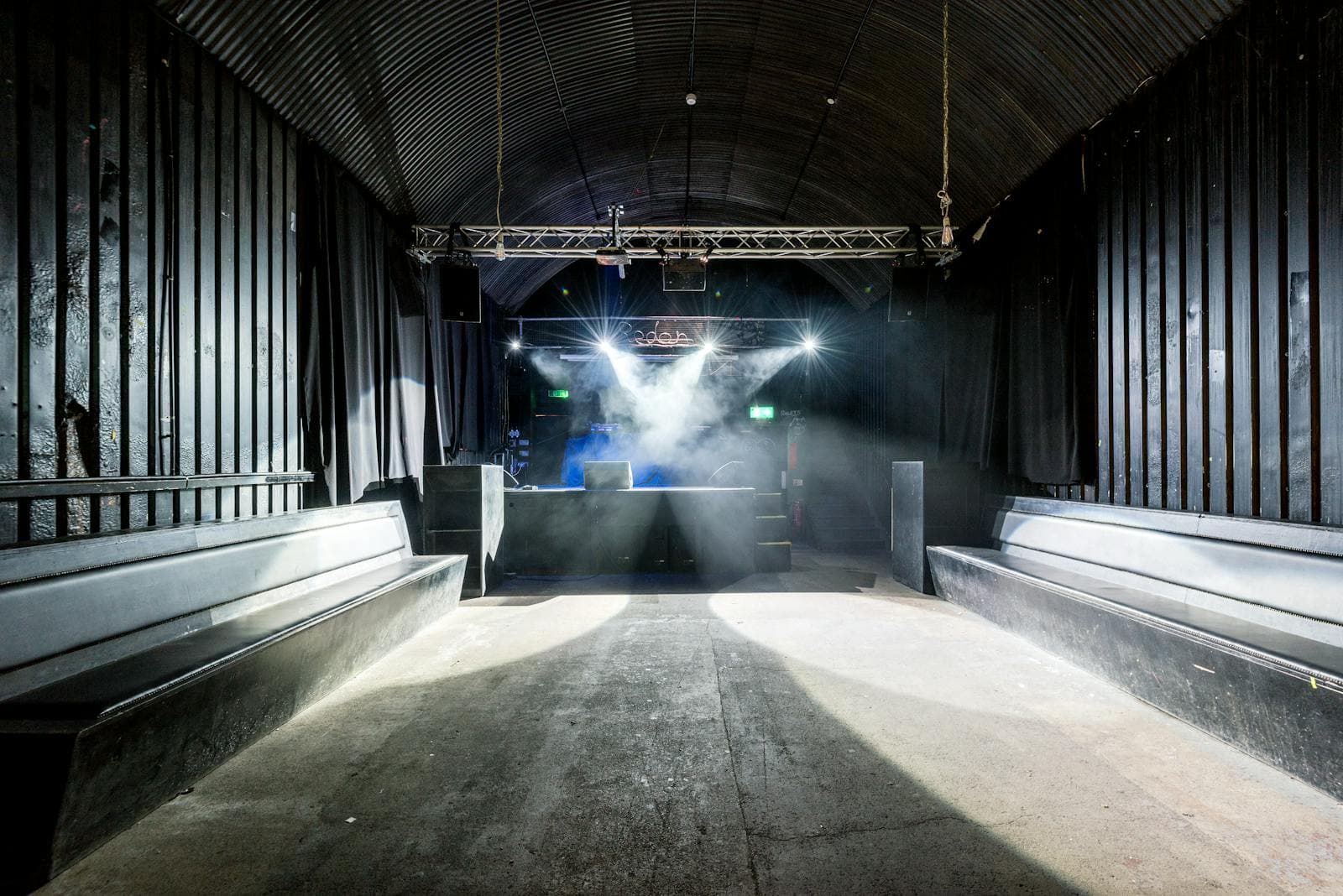
Empty nightclub interior with industrial design, stage lighting, and rows of seating awaiting guests
Key Takeaways
Every Swing.com review uses a six-pillar rubric — Vibe, Crowd, Hygiene, Safety, Value, Logistics — each scored 1-5 by at least two reviewers who attended independently and anonymously.
Comped entry, comped stays, and any vendor relationship are disclosed at the top of the review; paid placements are refused outright, and sponsored content is labeled.
Owner right-of-reply applies to verified factual errors — pricing, hours, capacity — and corrections are published within 48 hours; subjective reviewer impressions stand.
We refuse to review venues with documented consent violations, repeated safety complaints to local authorities, or that explicitly exclude protected classes beyond standard admission rules.
Any single review reflects one night, one crowd, and one reviewer team — weeknight versus weekend visits, holidays, and theme nights can shift the experience meaningfully, which is why we revisit and update.
Frequently Asked Questions
How does Swing.com review lifestyle events and clubs?
Every review uses a six-pillar rubric — Vibe, Crowd, Hygiene, Safety, Value, and Logistics — scored 1-5 by at least two reviewers who attended the event independently. We disclose comp stays, refuse paid placements, and publish corrections within 48 hours of verified errors.
Do you accept paid reviews from clubs?
No. We accept comp entry or stays for reporting purposes only, and disclose every comp arrangement at the top of each review. No club has editorial control over content or scores. Sponsored content, when published, is labeled clearly and never affects review placement.
Why do reviewers visit anonymously?
Anonymous visits ensure reviewers see what an ordinary couple sees — no VIP treatment, no curated tour, no inflated check-in service. Reviewers identify themselves only after the visit if needed for fact-checking with the venue.
What clubs or events does Swing.com refuse to review?
We don't review venues with documented consent violations, repeated safety complaints to local authorities, or that explicitly exclude protected classes beyond standard couple/single-male admission policies. We also pass on private-home parties unless invited with full host consent.
Can a club owner request changes to a review?
Owners can submit a right-of-reply for verified factual errors (operating hours, pricing, capacity), which we publish as a correction within 48 hours. Subjective scores and reviewer impressions are not editable post-publication, though follow-up visits can update scores over time.
Most lifestyle club and event coverage online is written by people who either own the venue, want to be invited back, or saw one good night and assumed every night looks like that. Readers deserve to know how a reviewer arrived at a score, what they looked at, what they ignored, and what they were paid (or not paid) for the trip.
This is Swing.com's editorial methodology for reviewing lifestyle clubs, parties, and events — so readers can trust what we publish, and so venues know exactly what we measure before we walk through their door.
Why Methodology Matters: Trust, E-E-A-T, and Reader Safety
A lifestyle review carries real consequences. Readers spend money, take time off, and sometimes travel internationally based on what we publish. Search engines now evaluate content under Google's E-E-A-T framework — Experience, Expertise, Authoritativeness, and Trustworthiness — and the Society of Professional Journalists' Code of Ethics sets the baseline industry expectation for accuracy and disclosure. A documented methodology is how we hold ourselves to both standards in public.
A bad review of a venue with a consent problem is dangerous. The reverse is true too: an unfairly negative review can sink a small operator running a safe room. The asymmetry of harm is why we write this down.
Google's Search Quality Rater Guidelines — the public document codifying the E-E-A-T framework — explicitly weight first-hand experience and transparent authorship. The Society of Professional Journalists Code of Ethics sets the parallel journalism expectation: minimize harm, act independently, be accountable. We use both as the trust contract underneath every club review on this site.
Our Six Scoring Pillars: Vibe, Crowd, Hygiene, Safety, Value, Logistics
Every Swing.com venue or event review is scored across six pillars on a 1-5 scale. Vibe captures the room's energy and welcome. Crowd describes who actually shows up — age, mix, demographic. Hygiene covers cleanliness of bathrooms, play surfaces, towels, and shared equipment. Safety covers consent enforcement, security presence, and house rules. Value measures what you get for the entry price. Logistics covers booking, parking, check-in, and how easy the place is to actually get into.
The six-pillar rubric exists so two readers comparing two reviews are looking at the same axes. A 4 on Crowd in Atlanta means what a 4 on Crowd in Las Vegas means: a healthy mix of couples and singles, a reasonable age spread, and no single demographic dominating the room.
Each pillar is scored independently by at least two reviewers who attended without coordinating notes. Final scores are the average, with disagreements (more than one point apart) flagged in the body and explained. A composite is published, but we encourage readers to read the pillar breakdowns — a club can be a 5 for Vibe and a 2 for Logistics, and that's the actual information a reader needs.
Hygiene and Safety are the two pillars where a low score is not smoothed over by strength elsewhere. A 5 Vibe and 2 Hygiene venue is not one we'd recommend. The composite reflects that.
Disclosure Standards: Comp Stays, Conflicts of Interest, and Anonymity
The Federal Trade Commission's Endorsement Guides require that reviewers disclose any material connection to the subject of a review — comped entry, comped travel, friendship with ownership, or sponsorship arrangements. We follow that rule strictly. Every review header lists what was comped, what was paid for at full price, and any other relationship that could reasonably be seen as influencing the coverage. Anonymous attendance is the default; identification happens only after the visit, for fact-checking.
The FTC Endorsement Guides are the governing standard for what reviewers must disclose. We treat them as the floor. If a venue comped two nights, the header says so. If a reviewer knows the venue owner socially, that is disclosed and a different reviewer is assigned where possible.
Reviewers attend anonymously by default — booked under personal accounts, paid entry, no staff identification, no curated tour. This is the only way to know what the experience is actually like for a reader walking in cold. Sponsored content, when published, is labeled and excluded from any "best of" list; sponsorship money does not buy placement or score adjustments.
How We Verify Claims: Site Visits, Cross-Referenced Reviews, and Member Interviews
A single visit is one data point. We cross-reference our own observations against the National Coalition for Sexual Freedom's published consent and community standards, recent reviews from other independent outlets, and conversations with Swing.com members who have attended the same venue. Pricing and operating-hour claims are verified against the venue's official site within seven days of publication. Anything we cannot independently verify is described as such in the prose, not stated as fact.
Reviewers triangulate against three sources before publishing: independent travel and lifestyle press where it exists, conversations with at least two Swing.com members who attended the same venue within twelve months, and the venue's own official communications verified against the live site within a week of publication.
The National Coalition for Sexual Freedom publishes consent and community-standards frameworks we use as the Safety reference. Where a venue's house rules differ from those frameworks, we note the difference and let readers draw their own conclusions.
What We Refuse to Review (and Why)
We do not review venues with documented consent violations, repeated safety complaints filed with local authorities, or admission policies that exclude protected classes beyond the standard couple-and-single-male framework most clubs operate within. We also decline to review private-residence parties unless the host has given full informed consent for editorial coverage. The goal is not to be punitive — it is to avoid amplifying venues whose problems make our review a marketing asset they don't deserve.
The harder cases are borderline: a venue with one credible complaint the owner addressed quickly, or an event series with one bad night in a string of good ones. We weight pattern over incident. Private-residence parties are categorically different — we will not review a private home party the host did not invite us to specifically for editorial coverage, with full understanding of what publication means.
How We Handle Updates, Corrections, and Owner Right of Reply
Verified factual errors — pricing, hours, capacity, named staff, dress code — are corrected within 48 hours of a credible report and noted in a changelog at the bottom of the review. Subjective scores and reviewer impressions are not editable after publication, though a follow-up visit can produce an updated review with revised scores and a new publish date. Owners may submit a right-of-reply for factual matters at any time; for subjective matters, a counterpoint may be published as a separate piece.
We don't quietly adjust scores after publication. A review is a moment in time with a documented rubric. If circumstances change — new ownership, a renovation, a re-launched programming calendar — we revisit, publish a new review, and link the old one as historical context.
The single thing we argue about most internally is the gap between what one reviewer felt at a venue and what another reviewer felt at the same venue six weeks later. The honest answer is that any review is a snapshot. We try to publish snapshots that are useful — clear about what we saw, when we saw it, and what we don't know — rather than pretend we've delivered a verdict that holds for every Saturday night for the next two years. That's why we revisit, why we publish updates, and why the methodology is the document we point to when readers ask why a score moved.
— Editorial team standards conversation
Reading a Swing.com Review: A Guide to Our Symbols and Scores
Each review opens with a disclosure header (comped or paid, anonymous or identified), a six-pillar score grid, and a one-paragraph composite. The body walks through each pillar with specific evidence. Internal links connect to related coverage — neighboring venues, regional guides, and the underlying lifestyle topics a venue's programming touches. The footer carries the publish date, the reviewer team, and a link back to this methodology document.
The header structure is the same on every review so readers don't have to hunt. Composite at the top; pillar breakdown next; prose body explains where each pillar score came from. Reviewer handles — for the same anonymity reasons that protect the visit — appear at the bottom, with the link back to this methodology as the last item.
For broader guidance on what to look for when you visit a venue yourself, our piece on becoming a better swinger covers reader-side etiquette in more depth. The Swing.com event calendar is where active venue and event coverage lives — reviewed venues are tagged so members can filter by score, region, or event type. Tips, counterpoints, and update requests submitted via the contact form are the most reliable way to influence our coverage queue.
 Community Editor··6 min read