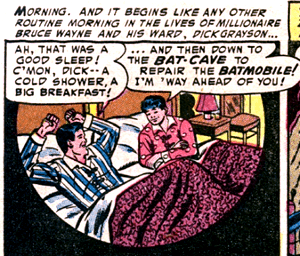
Vintage comic panel of Batman and Robin waking in twin beds, chatting in speech bubbles about breakfast
Key Takeaways
The article playfully analyzes pop culture clues suggesting Batman and Robin might be gay or bisexual.
The author uses humor to celebrate sexual openness and acceptance within the Swing.com community.
Swing.com welcomes people of all sexual orientations without judgment.
Frequently Asked Questions
Is Batman bisexual or gay according to popular culture?
The article humorously examines pop culture hints — such as two men living together, dressing in spandex, and double-entendre dialogue like 'C'mon Robin, slide down the Bat Pole' — as possible indicators that the Dynamic Duo may not be entirely straight. The author treats it lightheartedly, noting that whether gay, straight, or bisexual, the swinger community welcomes everyone without judgment.
Is the swinger lifestyle welcoming to gay and bisexual people?
Yes, Swing.com and the broader swinger lifestyle are welcoming to people of all sexual orientations. The platform does not judge members based on their sexuality and actively supports bisexual, gay, and queer individuals. The community is built on acceptance, openness, and the freedom to express one's sexuality without shame or stigma.
What does bisexuality look like in the swinger community?
Bisexuality is widely accepted and quite common in the swinger lifestyle. Many women and men identify as bisexual or bi-curious, and same-sex play is often a natural part of group encounters. Platforms like Swing.com welcome bisexual members and provide a non-judgmental space to explore attractions and connections with partners of any gender.
There is a running conversation in popular culture about which iconic characters might be bisexual, gay, or queer — and the lifestyle community tends to follow that conversation with genuine interest. Not because anyone needs a comic book character to validate how they identify. But because representation in media that reaches hundreds of millions of people carries real weight for real individuals navigating real stigma.
The Batman and Robin question — debated with everything from academic earnestness to cheerful irreverence since the comics first circulated — is one version of a broader conversation about how culture encodes, conceals, and occasionally acknowledges same-sex or queer dynamics. Whether any fictional character's sexuality is open to interpretation says less about the character than it does about who created them, when, and under what cultural constraints.
That conversation deserves more than a punchline. It also deserves honesty about what the community itself looks like.
Bisexual and Queer Members Are Not a Niche
The lifestyle community is often described from the outside as though it is primarily a straight-couples phenomenon. That description is inaccurate in ways that matter. Bisexual women, bisexual men, queer-identified members, pansexual individuals, non-binary participants, same-sex couples, and mixed-orientation configurations are not rare in lifestyle spaces — they are a defining and central part of the community.
Research summarized by the Kinsey Institute and the Journal of Sex Research has consistently shown that consensual non-monogamy communities skew toward higher rates of non-heterosexual identity than the general population. This is not surprising. Spaces built on honest acknowledgment of sexual complexity tend to attract people who have already done significant internal work around their own orientation and identity.
For bisexual members specifically, the lifestyle offers something that can be genuinely difficult to find elsewhere: an environment where same-sex attraction is not treated as a footnote, a phase, a performance for an audience, or a source of confusion. Bisexual identity is stable, real, and deserving of the same straightforward recognition as any other orientation — and the best lifestyle communities operate on that understanding.
What Good Representation Actually Looks Like
When superhero media and comics introduce explicitly bisexual, gay, or queer characters, the response within the lifestyle community tends to be direct: this is good, and it is overdue. The cultural conversation around which characters might be "secretly queer" exists partly because representation has historically required that secrecy — characters could be read as queer by those who knew how to look, but the text itself would not confirm it.
The shift toward explicit representation — characters whose bisexual or queer identity is written into the story rather than implied between the lines — matters because implication is not the same as inclusion. Members of the lifestyle community who identify as bisexual or queer know this from their own experience. Being accepted conditionally, in certain spaces, by certain people, is not the same as being welcomed plainly.
That standard applies to lifestyle spaces themselves, not just to the media they consume. A club or event that welcomes bisexual women but treats bisexual men with skepticism, or that welcomes same-sex female couples but not same-sex male couples, is applying an inconsistent standard that deserves direct naming. Genuine inclusion means the same welcome, the same norms, and the same community expectation of respect applies to every member regardless of orientation or gender identity.
The thing that mattered most when we joined the lifestyle was not whether the platform listed bisexual as an option in a dropdown — it was whether the actual community treated bisexual identity as real and complete rather than as a curiosity or a selling point. We have found both on the same platform at different times. The events and hosts who get it right are the ones where no one acts surprised when a man is openly bisexual, or when a same-sex couple is as central to the evening as any opposite-sex pair. That is what real inclusion feels like.
— Bisexual and queer-identified members on Swing.com we've heard from
Humor, Subtext, and Why the Conversation Matters
The original pop-culture game of reading queer subtext into fictional characters — Batman and Robin being one of the most discussed examples — began as playful speculation. It has also served a genuine function: naming that queer dynamics exist and have always existed, even in media that was not permitted to say so directly. The double-entendres, the shared living arrangements, the costuming choices that seemed to signal something — these were noticed because readers were looking for themselves in the available culture.
The lifestyle community contains many people who did exactly that: who found themselves in books and films and characters that could not quite say what they meant, and who later found communities where the thing could be said plainly. That experience of recognition-followed-by-belonging is a recurring story in lifestyle spaces, particularly among bisexual members and LGBTQ+ individuals for whom the lifestyle offered a first real community of open orientation.
Swing.com's Orientation-Inclusive Community
Swing.com's member profiles include fields for sexual orientation, relationship configuration, and what a member or couple is looking for. The search and matching tools allow filtering by orientation in both directions — members can find others with aligned identities and can signal their own clearly.
Bisexual members, queer individuals, same-sex couples, non-binary members, and mixed-orientation configurations are all present and active in the Swing.com community. The platform's group features include orientation-specific groups where members can find community within the broader community — a level of specificity that matters for members whose experience of the lifestyle has been shaped by their orientation in particular ways.
If you identify as bisexual, queer, or non-binary and are exploring what the lifestyle looks like for someone with your configuration, Swing.com's member community is one of the more honest places to start that exploration. The conversation there tends to be more direct than the one being had in comic book subtext — which is, on balance, an improvement.
 Swing Editorial··4 min read