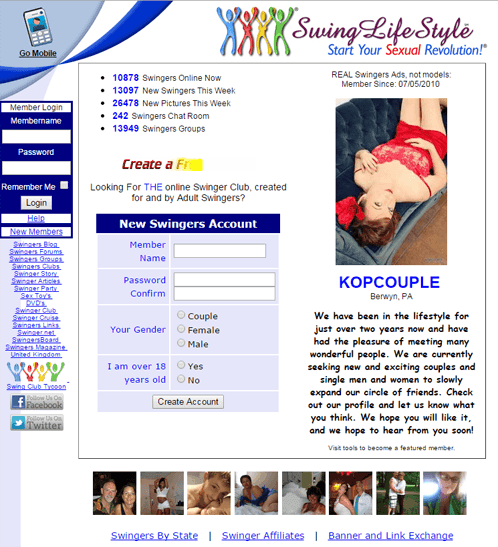
Screenshot of an older SwingLifeStyle homepage with signup form, member stats, and a featured couple profile panel
Key Takeaways
Verified platforms with active moderation and event calendars are the steady way couples find parties today — profile verification and host accountability make the difference.
Meet-and-greet socials held in public venues are the low-pressure first step that consistently produces better subsequent play experiences than jumping directly to a party.
Vetting party hosts — reading reviews, checking the host's platform history, looking at how the event is described — is ordinary community practice, not paranoia.
Reputable event networks, long-standing lifestyle conventions, and established on-premise clubs offer different entry points; couples often try several before settling into what fits.
Frequently Asked Questions
Where do couples actually find lifestyle parties in 2026?
The steady methods are verified platforms with active event calendars, reputable event networks and lifestyle conventions, meet-and-greet socials held in public venues, and referrals from trusted friends in the community. Swing.com is one current example of a verified-platform event calendar that couples use. Random search, unvetted listings on general forums, and invite-only promises from strangers remain the approaches most likely to produce either disappointing or unsafe experiences.
How do couples vet party hosts and events before attending?
Vetting practices are ordinary community behavior. Read recent reviews of the host and the event on the platform where it is listed. Check how long the host has been on the platform and what their profile actually says. Look at how the event itself is described — clear rules, explicit house norms, and transparent pricing are signals of a well-run event. If a host resists any of this scrutiny, that itself is a signal.
Should newer couples go directly to play events?
Generally no. The consistent community guidance is to attend meet-and-greet socials first — events held in public venues with a social rather than sexual format — before going to play parties. Meet-and-greets let couples see what the local community actually looks like, meet specific people fully clothed, and decide where they want to take things next, if anywhere. Couples who start with socials almost always report smoother later experiences than couples who skip that step.
The way lifestyle parties actually get found in 2026 is not the way it worked a decade ago. Random search on general forums, unvetted listings, and word-of-mouth from loose acquaintances used to be how much of the community operated. Most of that is gone, and the parts that remain are the parts that were never very reliable to begin with. What has replaced it is a layered system of verified platforms, event calendars, reputable event networks, and community vetting practices that together produce a significantly more predictable experience for couples moving through the consensual non-monogamy community. This piece walks through what that system actually looks like and how couples tend to use it.
The Verified-Platform Event Calendar
The steady way couples find parties today is through verified platforms with active event calendars. Profile verification, active moderation, community reporting tools, and host accountability are the features that actually filter experience — not any particular platform brand. The event calendar on a platform like this becomes the hub. Hosts post events with clear descriptions, house rules, pricing, and expected attendee profiles. Members RSVP publicly or privately. Reviews accumulate. Patterns become visible.
Swing.com is one current example of this kind of verified-platform event calendar, used by couples across the United States and internationally. Its utility is structural rather than unique — other reputable platforms operate similarly — but it is the example most likely to be in play for couples reading this. What matters is the category: verified, moderated, calendar-backed, and accountable to a community that shows up repeatedly.
Meet-and-Greet Socials as the Entry Point
Meet-and-greet socials are the consistent first step that produces better subsequent experiences. These are events held at public lounges, restaurants, and hosted lifestyle bars, with a social rather than sexual format. Couples and singles meet each other over drinks and conversation, fully clothed, without any expectation that anything will happen tonight. The value of starting here is twofold. First, it lets couples see what the local community actually looks like before committing to a higher-commitment event. Second, it lets specific couples decide whether they want to meet again somewhere more involved.
Newer couples who skip this step and go directly to play parties often report disjointed first experiences. The couples who move through meet-and-greets first — sometimes several before any play — almost uniformly describe a smoother entry into the community.
The pattern members describe most often when asked how they find good parties is not a secret. They check the platform calendar weekly. They attend meet-and-greets before play events. They read reviews of hosts before attending. They trust recommendations from couples they have built real friendships with over time. The single most repeated piece of guidance is "take your time" — the community rewards couples who show up consistently and build relationships, not couples who try to compress six months of community learning into one weekend.
— Lifestyle-active couples on Swing.com who have shared how they find events
Vetting Hosts and Events
Vetting practices are ordinary community behavior, not paranoia. Before attending an event, couples typically read recent reviews of the host and the event on the platform where it is listed. They check how long the host has been on the platform and what the host's profile actually says. They look at how the event is described — clear rules, explicit house norms, transparent pricing, and a visible track record are all signals of a well-run event.
If a host or event resists this kind of ordinary scrutiny — if reviews are unavailable, if pricing is vague, if house rules are not stated, if the host pushes for secrecy about anything that should be public — those are signals worth taking seriously. Well-run events welcome scrutiny because they have nothing to hide. Poorly run events avoid it.
Event Networks, Conventions, and On-Premise Clubs
Beyond the single-event calendar, the community offers three larger categories of infrastructure. Reputable event networks run recurring parties and takeovers across multiple venues and cities; they maintain their own reputation and vetting norms on top of whatever platform lists their events. Long-standing lifestyle conventions bring the national community together a few times a year and serve as a way for couples to meet a broader cross-section of the community than any single local event could. Established on-premise clubs run regular programming in specific venues, with their own community norms and membership structures.
Couples often try several of these categories before settling into what fits. Some find their rhythm at a local club. Others find it at a national convention once a year. Others live primarily through meet-and-greets and private parties within a trusted circle. There is no single right shape, and the community is large enough that multiple shapes coexist without contradiction.
 Community Editor··3 min read